Key Takeaways
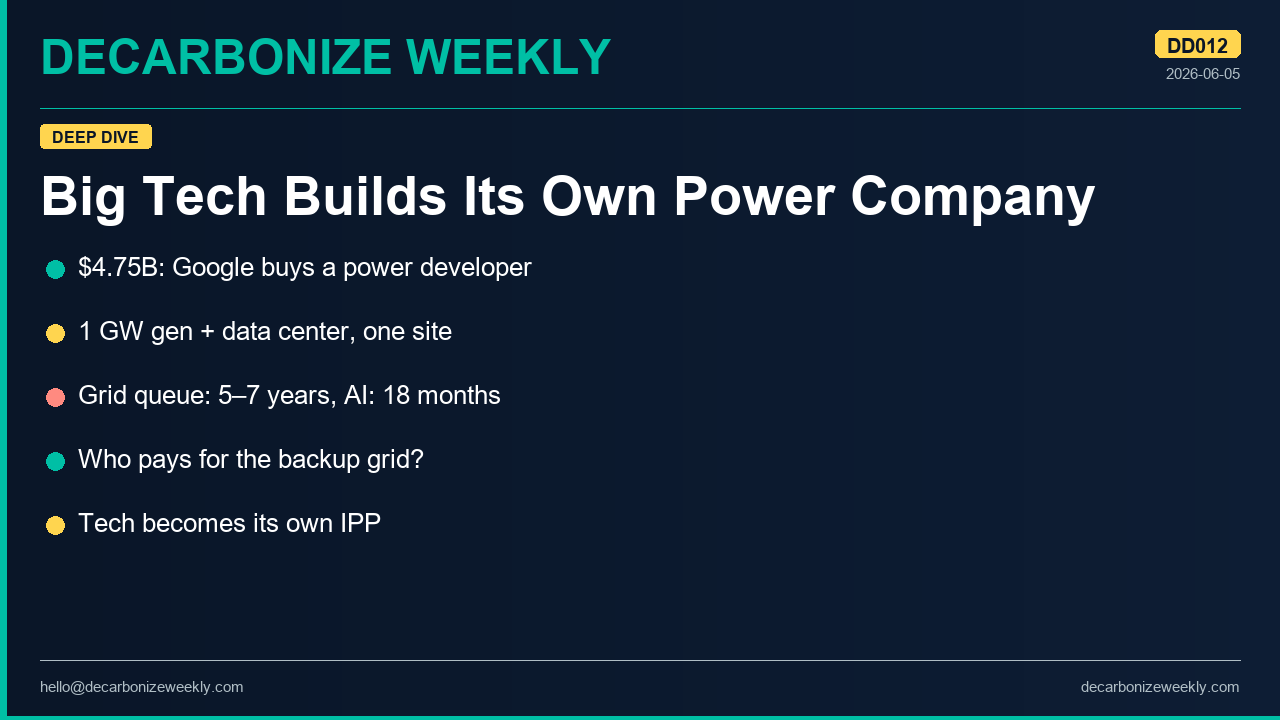
- Big Tech is building its own power plants. On June 5, 2026, Google and Intersect Power broke ground on the Meitner Energy Center in the Texas Panhandle — an AI data center co-located with more than 1 GW of new wind, solar, and battery storage, engineered so the generation and the compute energize together. The campus is built to draw its baseline load directly from the on-site plant rather than waiting years for the public grid to deliver it.
- Google bought the developer, not just the power. In March 2026, Alphabet closed a $4.75 billion acquisition of Intersect Power — not a power-purchase contract, but the clean-energy company that sites, permits, and builds generation. The deal brought in-house a full development pipeline plus 2.2 GW of operating solar and 2.4 GWh of storage, mostly in Texas and California. That is the difference between buying electricity and buying a power company.
- The interconnection queue is the reason. Roughly 2.6 terawatts of generation and storage sit waiting in US interconnection queues, with study-to-energization waits of five to seven years — while the AI hardware cycle turns over every 18 months. Co-location sidesteps the queue for the baseline load by permitting and building the generation and the data center as a single project, behind one point of connection.
- It is not 24/7 power — and that starts a grid fight. Co-located wind and solar plus roughly four-hour batteries cannot guarantee the ~99.9% uptime servers demand, so the campuses stay grid-connected and lean on the grid (or on-site gas) for backup. Because they generate most of their own power, their metered grid use — and their transmission charges — run low, which has opened a cost-shifting fight, templated by the 2025 FERC dispute over the Amazon–Talen co-location at the Susquehanna nuclear plant in PJM.
- The model re-verticalizes a 30-year-old industry. Since the 1990s, US power was deliberately unbundled into separate generation, transmission, and retail businesses. Hyperscalers — Google, Microsoft, Amazon, Meta — are reversing that on their own campuses, owning the developer, pouring the concrete, and acting as both generator and consumer. The question for the decade is not whether AI gets powered, but who ends up owning the power — increasingly, the technology companies themselves.
The Groundbreaking That Has Nothing to Do With Software
On June 5, 2026, one of the largest software companies on the planet started building a power plant. In Gray and Roberts Counties, in the wind-swept Texas Panhandle, Google and its partner Intersect Power broke ground on the Meitner Energy Center — and the project is not a data center in the conventional sense. It is an artificial-intelligence campus deliberately fused to more than a gigawatt of new wind, solar, and battery storage, engineered so the generation and the computing load come online together. The data center is designed to draw its baseline power directly from the adjacent plant, “without requiring excess power from the grid.”
That sentence is the whole story in miniature. For a century the arrangement was simple: a utility built the power plants, strung the wires, and delivered electricity to whoever needed it, and the customer’s job was to plug in. What broke ground in the Panhandle is the inverse — the customer building and owning the power plant because the public system can no longer move fast enough to serve it.
Meitner is not a one-off. It is the most visible point of a structural shift in which the largest technology companies are vertically integrating into electricity generation. The question worth a deep dive is not whether AI gets the power it needs. It is who builds and owns that power — the utility, or the tech company itself.
Buying Power vs. Buying the Power Company
The clearest signal came three months before the groundbreaking. In March 2026, Alphabet — Google’s parent — closed a $4.75 billion acquisition. It did not buy a large order of solar panels. It bought Intersect Power outright: the company that develops, finances, and builds clean-energy generation. A technology company bought a power company.
The distinction matters more than the price tag. For the past decade, hyperscalers secured clean power through power-purchase agreements — financial contracts to buy a set volume of electricity from an independent developer, delivered across the public grid. The electrons and the servers lived in different states; the relationship was contractual, not physical. Buying Intersect collapses that arrangement. It brings in-house a full development pipeline — the people who know how to find sites, win permits, and navigate interconnection — plus 2.2 GW of already-operating solar and 2.4 GWh of battery storage, mostly across Texas and California, along with the margin Google would otherwise have paid a developer on every project.
This is one of the cleanest examples of a broader 2024–2026 wave. Microsoft, Amazon, Meta, and the Stargate venture have all made aggressive power plays; most were contracts and reservations. Google’s was an acquisition. At the scale AI infrastructure now demands, the calculation is shifting: owning the developer is cheaper and faster than renting one.
A power-purchase agreement is a contract for electrons. Buying the developer and co-locating it changes who builds the plant, who keeps the margin, and where the electricity physically flows. It is a structural change, not a procurement tweak.
The Bottleneck: A Grid That Cannot Say Yes Fast Enough
To understand why a software company is suddenly pouring concrete, you have to look at the single mechanism causing the delay: the US interconnection queue. Whenever anyone wants to connect a new power plant — or a new large load like a data center — to the grid, they must apply to the regional operator for an engineering study. The operator models exactly how the new connection will affect voltage and capacity across the existing transmission network, because you cannot simply plug in a gigawatt and hope the wires hold.
The numbers are staggering. As of 2025, roughly 2.6 terawatts of generation and storage sit waiting in US interconnection queues — a volume comparable to duplicating the entire installed power fleet of the United States and leaving it in a waiting room. Because of that backlog, the wait to complete the studies and physically connect now runs five to seven years in the major regions. And that is only the generation side. A new AI data center is itself a giant new load that needs its own queue position, plus the multi-year construction of high-voltage transmission upgrades to deliver power to the site. In effect, a campus has to wait twice.
Two Clocks That Refuse to Sync
Lay the grid’s timeline against the technology industry’s, and the collision is obvious. Public transmission infrastructure moves in increments of half a decade. The AI hardware cycle moves in increments of eighteen months — roughly every year and a half a new generation of processors arrives and the last one starts depreciating toward obsolescence.
The financial consequence is brutal. A company cannot pour tens of billions of dollars into an AI campus, install thousands of high-value servers, and then leave them idle for six years waiting for a utility to string a wire. The chips would be obsolete before the switch was ever flipped, and the capital would earn nothing for years. It is the position of a freight company that has bought a fleet of new trucks only to be told the government needs six years to pave the road. Eventually the freight company decides to pave the road itself. That, precisely, is what the hyperscalers are doing: building the power source exactly where they build the data center, bypassing the multi-year wait for transmission entirely.
Co-Location: Putting the Power Plant Behind the Meter
The industry term for the architectural fix is co-location. It means sizing the on-site generation to match the servers’ demand and placing both behind the same single point of connection — sometimes on a private network with no public interconnection at all. The electricity flows directly from the panels and turbines into the data center; for the baseline load, it never travels across public transmission lines. The entire site — generation and load — is permitted, financed, and built as one integrated project rather than two separate multi-year queue entries.
That is a sharp break from the PPA model. Under a power-purchase agreement, the developer built the solar farm in one place and the data center sat in another, both waiting in the same five-to-seven-year queue, with electricity wheeled between them across the shared grid. Co-location eliminates that wait for the baseline load. It is the difference between renting capacity from a system you do not control and building the capacity yourself, beside the thing that consumes it.
When the grid cannot connect you for five to seven years and your GPUs cannot wait eighteen months, the rational move is to build your own power plant next to your own data center — and buy the company that builds it.
Why Owning the Developer Pencils Out
Co-location explains building on-site. It does not, by itself, explain buying the developer. That logic is about margin and scale. In a conventional project, an independent developer calculates the cost of materials and labor, adds a substantial profit margin, and sells the finished facility or its power to the tech company. That margin is how developers survive — and at gigawatt scale, replicated across many sites at once, it compounds into hundreds of millions of dollars of extra capital per site. Absorb the developer, and the markup disappears. At the physical scale of AI infrastructure, vertically integrating the developer is simply cheaper than contracting one.
The other half of the case is time and certainty. Reaching the grid sooner is worth more than a marginally cheaper kilowatt-hour when a delayed campus strands billions in idle processors; co-location buys speed, the scarcest input in the build-out. On-site solar and storage carry near-zero marginal cost and no fuel-price exposure, hedging decades of power cost on a balance sheet that can carry it. And owning the generation gives Google clean, additional, same-site electrons — far stronger toward its 24/7 carbon-free-energy goal than buying unbundled certificates. Control the developer, and you control the timeline, the cost structure, and the clean attributes end to end.
The Firmness Gap
There is a catch, and it is physical. Solar panels stop producing at night; wind turbines stop when the air goes still. But an AI data center training large models needs a continuous, uninterrupted supply — operational availability above 99.9%, essentially constant. The distance between what variable renewables can guarantee and what the servers require around the clock is what the industry calls the firmness gap.
Batteries close part of it — the 2.4 GWh Google just acquired is exactly this kind of asset — but today’s lithium-ion storage discharges for only about four hours. It cannot carry a gigawatt-scale campus through a three-day storm. So if you are picturing an off-grid fortress humming alone in the desert, that is the central misconception. Fully islanded sites are rare. The overwhelming majority of these campuses stay connected to the public grid, drawing primary power from on-site generation while the grid serves as the mandatory backup for when the wind drops and the batteries run flat. Some operators are beginning to add on-site natural gas, and many are eyeing small modular reactors in the 2030s for firm baseline power — but for now, the public grid is the backstop.
Who Pays for the Backup? The Cost-Shifting Fight
That reliance on the grid as an insurance policy has triggered the most consequential dispute in the whole story, and it turns on a concept called cost-shifting. The transmission network is maintained through charges on customers’ bills, typically scaled to how much energy they pull from the grid. But a co-located campus generates most of its own power, so its metered grid usage — and therefore its transmission payments — are very low. The question regulators and ratepayer advocates are now asking is blunt: how much public infrastructure can a private company hold in reserve as backup without paying its share to build and maintain it?
The hyperscalers have a fair retort — they are spending billions to reduce their daily strain on the grid, so why should regulators intervene at all? The answer is that the grid is a single shared physical network. A campus that suddenly loses its on-site wind and instantly pulls a gigawatt from the public system forces the transmission infrastructure to be sized for that maximum instantaneous demand, not the average. If it is not, the failure is not contained to the campus — voltage and frequency shift across the whole region, and neighborhoods go dark. This is not hypothetical. In 2025, the Federal Energy Regulatory Commission took up a co-location arrangement between Amazon and Talen Energy at the Susquehanna nuclear plant in the PJM region; a utility formally challenged it, arguing Amazon was receiving the reliability benefits of the broader grid without paying the associated tariffs. The rules being written out of that fight will shape the physical layout of the entire American power industry.
After thirty years spent deliberately unbundling the power industry, the AI build-out is quietly re-verticalizing it — one campus at a time, on a handful of balance sheets.
Power-First, and the Re-Verticalization of Electricity
While the lawyers argue tariffs, the engineers have already changed how they choose where to build. The old sequence put a data center near fiber-optic backbones or population centers and then asked the local utility to deliver power. That order is now dead. Companies search first for regions with abundant generation potential — open land near high-voltage substations, with strong wind and solar resources — and only then build the campus there. That “power-first” logic is exactly why Meitner is rising in the Texas Panhandle: not a population center or a data hub, but wind-rich, land-rich, and inside an ERCOT grid whose energy-only market carries lighter interconnection rules than the heavily regulated systems in the north. Capital flows to wherever the resource and the rules let it pour concrete fastest.
Step back, and the deeper reversal comes into focus. From the late 1990s, US regulators deliberately unbundled the power industry — splitting generation, transmission, and retail into separate companies to prevent the vertically integrated monopolies of the past. That structure has defined the market for a generation. The hyperscalers are now reversing it on their own land: acquiring the developers, building the plants, and acting as both the sole generator and the sole consumer behind a single meter. The traditional utilities, meanwhile, are watching the fastest-growing source of electricity demand in the country — AI — build its own supply and walk away from their rate base.
Bottom Line
For thirty years the power industry pulled itself apart, and data centers bought clean electricity as a service, delivered over a grid everyone shared. The AI build-out is reversing that. Google’s $4.75 billion purchase of Intersect Power and the Meitner groundbreaking are the clearest signal yet that compute and electrons are merging onto the same balance sheet — fast, clean, and capital-efficient for the handful of companies that can afford it, and leaving unresolved the question of who funds the grid everyone still leans on for backup.
Three things are worth watching. First, the FERC and PJM rulings on co-location cost allocation: whether co-located mega-loads are made to pay for the backup they rely on will decide how far the model can scale. Second, whether other hyperscalers follow Google from contracting developers to acquiring them outright. And third, how much gas — and, eventually, nuclear — quietly creeps in behind the “clean co-location” headline to close the firmness gap. The question for the rest of the decade is not whether AI gets powered. It is who ends up owning the power — and the answer, increasingly, is the technology companies themselves.