Key Takeaways
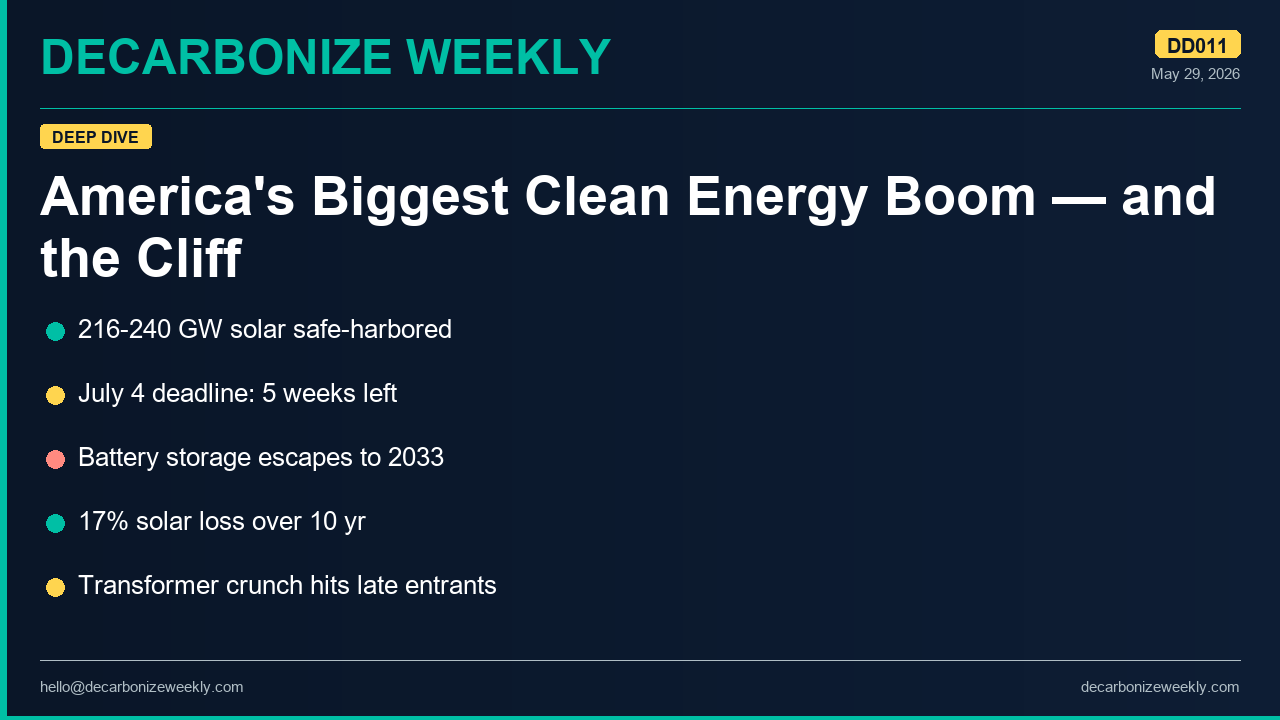
- The paradox: The One Big Beautiful Bill Act, signed July 4, 2025, was designed to end the IRA's clean-energy tax credits. But it set a hard deadline rather than an immediate cutoff — projects that begin construction by July 4, 2026 keep the old economics — and that deadline triggered the largest voluntary construction mobilization in US energy history. Between 216 and 240 GWdc of solar is being “safe-harbored” before the date, a volume equal to projected US solar installs for the rest of the decade, compressed into one 18-month sprint.
- “Begin construction” got much harder. In January 2026 the IRS killed the old 5% safe harbor — you could once qualify by spending 5% of project cost on equipment and stacking panels in a warehouse. Now it takes “significant physical work” on the actual site: foundations poured, steel erected, trenches dug. Procurement no longer counts, which is why money alone cannot manufacture a qualifying construction start in the final weeks.
- The ITC is the financing, not a subsidy. The 30% Investment Tax Credit (up to 50% with domestic-content and energy-community bonuses) is sold to corporate tax-equity investors at ~85–95 cents on the dollar, providing the upfront capital that closes the deal. Strip it out and a utility-scale solar project's unlevered return falls from ~9–12% to ~4–6% — below what a risk-free Treasury pays, so capital simply walks. That is why July 4 is existential, not cosmetic.
- Battery storage escaped. The OBBBA preserved the full storage ITC through 2033 — seven extra years that solar and wind do not get. Storage isn't seen as merely “green”; grid operators in Texas, the Mid-Atlantic, and the Midwest treat it as critical reliability infrastructure for an AI-data-center demand boom. A record 24 GW of US storage is planned for 2026, and the global grid-battery market is racing toward $67.5 billion by 2033.
- The boom is real; so is the cliff. The US is on track for a record 86 GW of new generating capacity in 2026, solar and storage leading. But the 10-year US solar output forecast under the OBBBA is ~17% below the IRA-continuity baseline — roughly one-fifth less solar this decade. Globally the transition is unaffected: BNEF still projects solar as the world's largest single source of electricity by 2032. The US simply contributes a smaller share of it.
The Setup — A Deadline, Not a Market
Count forward five weeks from the end of May 2026 and you land on July 4. On that exact date, a heavy door swings shut on the US energy sector — the kind of hard stop the industry has not seen in its modern history. And the strange thing, the thing worth an entire deep dive, is that the law slamming the door was written to discourage the very thing it is now causing a frantic rush to build.
The One Big Beautiful Bill Act, signed July 4, 2025, was the central fiscal vehicle of the Trump administration's second term, and its clean-energy provisions were unambiguous: end the Inflation Reduction Act era of stackable tax credits. But the drafters did not flip a switch to zero on signing day. For utility-scale solar and wind, they wrote a deadline — begin construction by July 4, 2026, and you keep the full, lucrative IRA-era economics, with up to four years to finish. Miss it, and the credits are gone.
A deadline on a valuable thing does not make people stop. It makes them rush. Imagine a store announcing it will permanently cancel its 30-to-50%-off discount in exactly one year; shoppers do not shrug, they try to buy a decade of inventory in an afternoon. That is precisely what the hard data shows. Across the country, developers are racing to “safe-harbor” between 216 and 240 gigawatts of solar capacity before the deadline — a volume equal to the United States' projected solar installations for the entire rest of the decade, mobilized in a single compressed window.
The question worth asking is not whether the boom is real. It is. The question is what the boom costs once the door is locked — and which projects sprinting toward it actually make it through.
How a Bill Meant to End Renewables Supercharged Them
The Inflation Reduction Act of 2022 was the largest clean-energy investment in US history, built on a suite of technology-neutral, stackable tax credits: a 30% Investment Tax Credit on project capital, a per-kilowatt-hour Production Tax Credit for generation, a standalone credit for battery storage, and per-unit manufacturing credits. It unlocked a projected $3.2 trillion pipeline of announced projects and factory groundbreakings.
The OBBBA took that apart, but selectively. Residential credits — for EVs, home efficiency, chargers — were terminated by the end of 2025. Utility-scale solar and wind were handed the July 4, 2026 construction deadline. Battery storage, crucially, kept its full credit all the way through 2033. And a new set of Foreign Entity of Concern rules threatened any project leaning on Chinese-linked supply chains. The throughline is that the bill did not end clean energy on a date — it created a structure of deadlines and asymmetries, and the nearest deadline became the loudest market signal in the sector.
Academic analysts have not missed the irony. The Georgetown Environmental Law Review concluded that a bill drafted to rein in clean-energy support had inadvertently created conditions for what it called the most significant short-term expansion of clean-energy infrastructure in US history. That is not a contradiction; it is the logical result of a hard deadline attached to a hard incentive. Nothing motivates a capital-intensive industry like the threat of a closing window.
An anti-renewable bill set a deadline, and the deadline became a forcing function no market signal could replicate. The boom is not the irony — it is the mechanism working exactly as a deadline works.
What “Begin Construction” Now Means
The entire rush turns on a piece of tax-law plumbing: what it means to have “begun construction.” Under the old rules, developers relied on the 5% safe harbor — incur 5% of the total project cost, typically by buying equipment, and you had legally started. In practice that meant a developer could purchase 5% worth of solar panels, stack them in a warehouse in Nevada, and tell the IRS construction had begun. It was permissive by design.
In January 2026 the IRS closed that pathway. To meet the July 4 deadline now, a developer must demonstrate “significant physical work” on the actual site — pouring concrete foundations, erecting steel racking, digging trenches. Procurement, permits, and deposits no longer count. The distinction sounds technical, but it is the whole game, because it means money cannot simply manufacture a construction start in the final weeks.
Here is the trap. If physical work is all that is required, why can't a well-capitalized developer just hire every excavator in the county and start digging? Because you cannot dig a hole to nowhere. You cannot install racking without the specialized steel, and you cannot do meaningful electrical work without the grid components. Money cannot alter the physical reality of global supply chains — and that reality is where the sprint meets its real obstacles.
The ITC Is the Financing, Not a Subsidy
To see why the deadline is existential rather than merely expensive, you have to understand that the Investment Tax Credit is not a nice-to-have on top of an already-viable project. It is the financing mechanism. The 30% base credit — rising to 50% with domestic-content and energy-community bonuses — can equal half the cost of a multi-billion-dollar plant, paid through the tax code.
But a tax credit is not a briefcase of cash. A developer spending hundreds of millions on infrastructure and depreciating those assets often has little taxable income for years, so it cannot use a $100 million credit itself. That is what the tax-equity market is for. Large corporate taxpayers — banks, tech giants, big retailers — buy the credits from the developer at roughly 85 to 95 cents on the dollar. The corporation gets a discount on its IRS bill; the developer gets upfront, real capital to pour concrete and buy transformers. This is how a paper credit becomes a building.
Now strip it away. Without tax-equity cash, the unlevered internal rate of return on a typical utility-scale solar project falls from roughly 9–12% to about 4–6%. Developers call 4% “unfinanceable,” and the reason is the alternative: an institutional investor can buy a US Treasury bond at four or five percent with zero risk. Why take on a two-year construction project — weather delays, supply-chain shocks, permitting lawsuits — to earn the same return you could get sitting on a government bond? You wouldn't. Capital flows to the path of least resistance, and without the ITC the math simply does not justify the risk.
The ITC is not a bonus on a viable project. It is the financing mechanism — strip it out and a utility-scale solar return falls below a risk-free Treasury, and the capital structure does not close.
Four Bottlenecks Between a Sprint and a Finish Line
Getting through the safe-harbor window is no longer a paperwork exercise; it is a physical traffic jam, with everyone trying to leave a stadium through one revolving door. Four bottlenecks decide who makes it.
The first is transformers. High-voltage transformers — the custom, engineered units that step a solar farm's output up to transmission voltage — have a two-to-four-year global lead time, driven by a shortage of specialized electrical steel and surging demand from data centers and grid upgrades. A developer who did not order substation equipment by late 2023 or early 2024 cannot conjure it now. The hardware does not exist yet.
The second is the interconnection queue. Plugging a 500-megawatt solar farm into the grid requires exhausting engineering studies to ensure the new power will not destabilize the network. In major regions — PJM in the Mid-Atlantic, CAISO in California — the wait just to clear those studies and receive a grid-connection agreement now runs five to seven years. If you were not deep in that queue half a decade ago, no amount of money fast-tracks the physics.
The third is FEOC compliance. Chinese companies supply roughly 70% of US utility-scale solar panels, typically 15 to 30% cheaper than domestic alternatives. Under the OBBBA, a project receiving “material assistance” from a Foreign Entity of Concern loses its credit entirely — so the panels that make up most of global supply will vaporize the tax credit if used. Developers must scramble for premium US-made modules from Qcells or First Solar, and so is everyone else, all at once, against a domestic base that was never scaled for an overnight 200-plus-gigawatt rush. The fourth bottleneck is the most human: labor. The artificial deadline has compressed years of construction sequencing into months, and every developer needs the same crane operators, high-voltage electricians, and ironworkers at the same time, with predictable wage inflation and schedule slips.
The One Technology That Escaped
Amid the panic, one clean-energy technology is sitting comfortably on the sidelines: battery storage. Under the OBBBA, storage keeps its full ITC eligibility all the way through December 2033 — seven extra years that solar and wind simply do not have. Why the double standard?
Because policymakers do not see storage as merely “green.” They see it as critical grid-reliability infrastructure. Grid operators in Texas, the Mid-Atlantic, and the Midwest are managing unprecedented, exponential demand growth — much of it from AI data centers that draw staggering, constant power — while also handling the daily evening drop-off, when solar fades but demand spikes as people get home and turn on the air conditioning. Massive batteries absorb power when it is abundant and discharge it when the grid would otherwise strain. The arguments that saved the storage credit were about energy security, economic stability, and resilience, not climate — and that framing is exactly why they survived a bill aimed at cutting clean-energy support.
The financial market read the seven-year runway clearly. A record 24 GW of utility-scale storage is planned for US deployment in 2026 alone, and the global grid-scale battery market is rocketing toward a projected $67.5 billion by 2033, with low-cost lithium iron phosphate chemistry dominating. While solar and wind sprint toward a brick wall, battery developers are jogging on a padded track.
Booming and Unraveling at the Same Time
The cleanest snapshot of the paradox came from Electrek in late May 2026, which summed up the moment in one line: US clean energy is booming and unraveling at the same time. In the first quarter of 2026 alone, 54 new large-scale renewable projects were announced — nearly double all of 2025. In that exact same three-month window, 38 projects were formally canceled — nearly half of all 2025 cancellations.
That whiplash is the safe-harbor sprint sorting the pipeline in real time. The projects that had the foresight to order transformers years ago, lock in grid positions early, and secure compliant supply chains are booming. The ones that tried to jump in late are hitting the brick wall of physical reality and unraveling completely. The headline number — a record 86 GW of new US generating capacity expected in 2026, with solar at roughly half and storage at nearly a third — is real. So is the shake-out underneath it.
The Cliff Beneath the Boom
Now fast-forward to July 5, 2026, when the dust settles and the door is locked. This is where the structural damage hiding beneath the short-term boom becomes visible, and the data is sobering: the 10-year US solar output forecast under the OBBBA is roughly 17% lower than it would have been under continuous policy support. That is a fifth of a decade's solar generation removed from the board — the country effectively traded stable, predictable growth for a chaotic adrenaline spike followed by a cliff.
After July 4, the pipeline for new utility-scale solar and wind gets thin very quickly. Projects that did not break ground are largely stranded — utility-scale solar takes three-plus years from planning to operation, which makes the December 2027 placement-in-service backstop unreachable for late entrants. Developers will trim headcount, and activity shifts to the places that still pencil: battery storage on its 2033 runway, states with strong renewable portfolio standards (California, New York, Illinois, Colorado, New Mexico), and smaller distributed-generation projects with different financing.
It is worth being precise about what the cliff is and isn't. Battery storage keeps growing at record pace. Offshore wind, geothermal, and nuclear credits are largely retained. The sharp cutoff lands primarily on utility-scale solar and onshore wind — the workhorses of the last decade's buildout. That is a serious blow, but it is not the end of the clean-energy sector.
The boom is a sprint, not a runway. The 17% it quietly removes from the next decade of US solar is the part that never makes the headlines.
The Rest of the World Doesn't Brake
Does a 17% cut in the world's largest economy mean the global energy transition is failing? No — and it is important to separate US policy from the impartial global data. The broader transition is largely unaffected by the OBBBA. BloombergNEF's New Energy Outlook 2026, released May 19, still projects solar to become the world's largest single source of electricity by 2032. The physics and economics of global energy do not stop because the US altered its tax code.
What changes is the US share. The United States transitions from a market-leading driver of the global buildout into a secondary market by new-capacity share. Capital is fluid; sovereign funds and multinational developers simply pivot, and Germany, India, Australia, Brazil, and Chile expand to fill the void. The global momentum continues. America just plays a proportionately smaller role in it — with the conspicuous exception of battery storage, where AI-data-center demand and the retained 2033 credit keep the US a leading market.
Bottom Line
The One Big Beautiful Bill was built to end the IRA era. Instead, through the quirk of a hard, unforgiving deadline, it created a record-breaking 86-gigawatt construction sprint in a single year. The boom in the headlines is entirely real, and the cliff on July 4 is just as real. Both things are true at once, and the outcome of this five-week scramble will directly shape the supply and cost of the electricity powering American homes — and whether regional grids can host the next wave of AI.
Three things are worth watching as 2026 closes. First, how strictly the IRS enforces “significant physical work” — a permissive reading broadens the qualifying pool, a strict one disqualifies marginal projects and could make a chunk of that 240 GW vanish overnight. Second, the gap between safe-harbor announcements and steel actually in the ground — how much of the frenzy was real construction versus corporate posturing. And third, state-level action: whether California, New York, Illinois, and Colorado step up with their own incentives to catch the baton the federal government just dropped. The aggression and pace of that state response will determine, more than anything else, how steep the July 5 cliff really is.