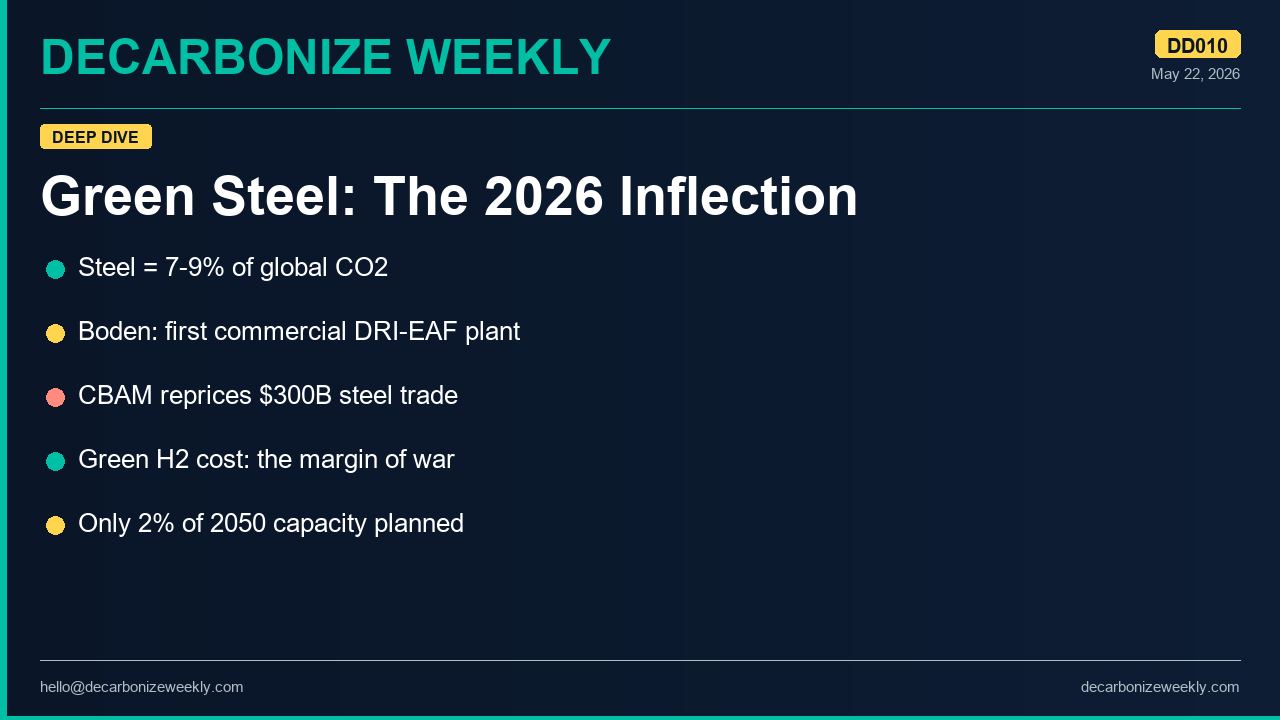
Key Takeaways
- The event: Stegra's Boden plant in northern Sweden is entering commissioning — the world's first full-commercial-scale plant that makes steel from green hydrogen instead of coal. €3.5 billion invested, 2.5 million tonnes a year of fossil-free steel at full ramp, roughly 800,000 t/year of green hydrogen backed by about 4 GW of dedicated renewable power. After two decades of pilots, this is the first time the entire green-steel supply chain has been verified at industrial scale.
- It's the chemistry, not the combustion. Steel is hard to decarbonize because making iron requires a chemical reductant to strip oxygen from iron ore — and for 150 years that reductant has been coal. You cannot simply electrify the reaction. The DRI-EAF pathway swaps the coal for hydrogen in a direct-reduction shaft furnace, then melts the result in an electric arc furnace. At 100% green hydrogen and renewable electricity it cuts steel's carbon intensity from ~2.1 to ≤0.3 tonnes of CO2 per tonne of steel.
- CBAM is the market mechanism. On January 1, 2026 the EU's Carbon Border Adjustment Mechanism entered full enforcement, with steel and iron in the first wave. Importers must now buy certificates for the embedded carbon in their steel — Turkish, Indian, and Ukrainian exporters report €30–80/tonne in added cost. That repricing erases most of the cost advantage high-carbon imports held in the European market, narrowing green steel's premium from a chasm to roughly €100–200/tonne.
- The economics still hinge on hydrogen. Each tonne of direct-reduced iron needs ~55 kg of green hydrogen. At 2026's ~€6/kg, hydrogen alone adds ~€330/tonne; break-even against natural-gas DRI needs €2–3/kg, which requires renewable power near €30–40/MWh — achievable in the best Northern European locations by 2028–2030. Until then, what makes Boden financeable is forward demand: Volkswagen, Mercedes, and BMW have locked multi-year offtake at €100–300/tonne premiums for 2027–2032. Buyer pull, not spot competition.
- Real, but not yet transformative. About 70% of global steel is still made the old way, and China alone is ~57% of world output with roughly 4 billion tonnes of blast-furnace capacity built between 2000 and 2020 — 20 to 35 years of economic life remaining. Even the optimistic 2030 scenario of 50–80 Mt of green steel is under 4% of global production. 2026 is a genuine commercial inflection and a credible market signal; the transformation, if it comes, lands in 2035–2040 and turns on whether green hydrogen gets cheap and whether carbon pricing reaches the blast-furnace majority.
The Setup — Two Events on One Continent
Steel is the skeleton of modern civilization, and it is also one of its dirtiest industries. Making it accounts for roughly 7–9% of global carbon dioxide emissions — about 2.3 billion tonnes a year — which makes steel the single largest industrial source of CO2 after power generation. For two decades the way to clean it up has been understood in theory: stop burning coal to make iron, and use hydrogen instead. The theory never got built at commercial scale. In 2026, on one continent, two things change at the same time.
The first is a plant. In Boden, in the north of Sweden, Stegra — the company formerly called H2 Green Steel — is bringing online the world's first full-commercial-scale facility designed to make steel from green hydrogen. The numbers are not pilot numbers: €3.5 billion of capital, a target of 2.5 million tonnes of fossil-free steel a year, and a dedicated renewable power and electrolyzer supply feeding the furnace. This is the proof-of-concept the industry has been waiting twenty years for.
The second is a law. On January 1, 2026, the European Union's Carbon Border Adjustment Mechanism — CBAM — entered full enforcement, and steel is in the first wave of covered sectors. From now on, anyone importing steel into the EU has to pay for the carbon embedded in it, at the same price a European producer would pay under the EU's emissions trading system. A plant that proves the technology, and a law that changes the price of not using it. That combination is what makes 2026 the year green steel stops being a slideshow.
The question worth asking is not whether green steel can be made — Boden answers that. It is whether the economics can cross before the world's enormous fleet of coal-fired blast furnaces runs out its natural clock. That is the question this piece is about.
Why Steel Is the Hard One
To understand why this took twenty years, you have to understand why steel is genuinely harder to decarbonize than electricity or cars. There are three structural reasons.
The first is chemistry. Iron arrives from the ground as iron oxide — iron bonded to oxygen, Fe2O3. To make metal, you have to break that bond and pull the oxygen off, a process called reduction. Reduction needs a chemical reductant, something the oxygen would rather bond to than the iron. For 150 years that reductant has been carbon, supplied as coking coal, and the reaction unavoidably produces CO2. This is the crucial point that trips people up: you cannot fix steel by plugging the furnace into a wind farm. The emissions are not from heating the iron, they are from the chemical reaction that makes it. You need a different reductant. Hydrogen is the clean one — it strips the oxygen and the only by-product is water.
The second reason is scale. The world makes about 1.9 billion tonnes of steel a year. Even if green steel captured 5% of that market by 2030, that is roughly 95 million tonnes — on the order of forty Boden-sized plants, each a multi-billion-euro build. The capital wall is immense.
The third is lock-in. A blast furnace lasts 30 to 40 years. The enormous fleet that China and India built between 2000 and 2020 is, on paper, good until somewhere between 2040 and 2060. Nobody scraps a profitable asset early without a reason, which means the transition cannot simply wait for old equipment to retire. It has to be pulled forward by early-mover markets while conventional production keeps running everywhere else.
The Pathway — Swapping Coal for Hydrogen
The winning technical route has a name that sounds like alphabet soup but is worth knowing: DRI-EAF, for Direct Reduced Iron into an Electric Arc Furnace. It is best understood as two steps.
Step one is direct reduction. Iron ore pellets are fed into a tall shaft furnace and a hot reductant gas is blown up through them at 800–900°C. The gas strips the oxygen out of the ore in the solid state — the iron never melts — and what drops out the bottom is a porous, metallic product called sponge iron, or DRI. The trick that makes this matter for the climate is that the reductant gas can be changed. Direct reduction on natural gas is a mature, century-tested industry; the Midrex and Tenova processes run worldwide. Converting that gas feed from natural gas to hydrogen is an incremental engineering change, not a leap into the unknown. That is why this pathway, and not some exotic alternative, is the one going commercial first.
Step two is melting. The sponge iron — on its own or blended with scrap — goes into an electric arc furnace, which melts it with electricity rather than burning coal. The carbon intensity of an EAF depends entirely on the grid that powers it. On renewable electricity, it is nearly zero.
Put the two clean steps together and the math is decisive. Conventional blast-furnace steel emits about 2.1 tonnes of CO2 for every tonne of steel. DRI-EAF running on 100% green hydrogen and renewable electricity comes in at 0.3 tonnes or below — an 85%-plus cut. There is even a more radical route waiting in the wings: Boston Metal's molten oxide electrolysis, which electrolyzes molten iron ore directly with electricity and skips the reductant gas altogether. It is earlier-stage, targeting commercial scale around 2030, but if it works it could leapfrog the entire hydrogen supply problem.
You cannot fix steel by plugging the furnace into a wind farm. The emissions are not from heating the iron — they are from the chemical reaction that makes it.
What Boden Actually Is
Boden is where that diagram becomes a building. The plant pairs hydrogen-based direct reduction with electric arc melting on a single site in a part of Sweden chosen for one reason above all: cheap, abundant, low-carbon power. At full capacity it is designed to produce 2.5 million tonnes of fossil-free steel a year, consuming on the order of 800,000 tonnes of green hydrogen, with roughly 4 GW of dedicated renewable generation and on-site electrolysis behind it. The EU Hydrogen Bank's support mechanism was a key financing anchor.
Two things about Boden are easy to underestimate. The first is that the commissioning ramp is gradual — output climbs from an initial ~0.5 Mt/year toward the 2.5 Mt design figure, and the early months are about proving yields and reliability, not flooding the market. The second is the product itself. A persistent myth holds that this kind of steel is second-rate; Boden is explicitly aimed at automotive-grade and construction-grade flat steel, the high-value stuff. Its offtake book — Volkswagen, Mercedes, BMW — would not exist if the metal could not meet their specifications. Boden is not making a green-tinted compromise. It is making the same steel, without the coal.
CBAM — The Mechanism That Changes the Math
A proven plant is necessary but not sufficient. Green steel has always been more expensive than the coal-fired kind, and in a commodity market the cheaper tonne wins. CBAM is the policy that bends that logic.
The mechanism is straightforward. The EU already charges its own producers for carbon through the emissions trading system, currently around €70 per tonne of CO2. That created an obvious loophole: import steel made somewhere with no carbon price, and you dodge the cost while undercutting European mills. CBAM closes the loophole by charging importers for the embedded carbon in covered goods — steel, iron, cement, aluminum, fertilizer, hydrogen — at the EU carbon price. High-carbon steel from Turkey, India, and Ukraine is now landing with a reported €30–80 per tonne of added cost, and as the free allowances EU producers historically received are phased out, that figure climbs.
Run the cost stack and the effect is visible. Imported conventional steel that used to land around €400–450 a tonne now carries a CBAM surcharge that pushes it toward €470–590. Green steel from Boden sits around €700–900 today and is projected toward €600–750 by 2028 as hydrogen costs fall. The premium that once looked unbridgeable — green steel against the cheapest dirty import — is compressing toward €100–200 a tonne, and shrinking every year the carbon price holds. CBAM does not make green steel cheap. It makes dirty steel expensive, and in a carbon-priced market those are the same thing.
CBAM does not make green steel cheap. It makes dirty steel expensive — and in a carbon-priced market, those are the same thing.
The Economics — Hydrogen Is the Lever, Offtake Is the Bridge
If you want to know whether green steel wins, watch one number: the price of green hydrogen. It takes roughly 55 kilograms of hydrogen to make a tonne of direct-reduced iron, so the hydrogen bill dominates the operating cost. At 2026's roughly €6 per kilogram, hydrogen alone adds about €330 to every tonne of DRI. At a projected €3/kg toward 2030, that halves to ~€165. At an optimistic €2/kg in the mid-2030s, it falls to ~€110.
The threshold that matters is break-even against natural-gas DRI, which sits around €2–3 per kilogram of hydrogen. Hitting it requires renewable power in the €30–40/MWh range and electrolyzer capital costs below about €400/kW — conditions achievable in the best-resource Northern European locations by 2028–2030. BNEF's latest New Energy Outlook, released May 19, projects renewable electricity below €30/MWh in the best Northern European sites by 2030, which is exactly the input that drives Boden's hydrogen cost down over time. The cost curve is not a hope; it is a trajectory with a date on it.
But trajectories take years, and Boden has to be financed today. The bridge across that gap is forward demand. Volkswagen, Mercedes, and BMW have signed multi-year offtake contracts at premiums of €100–300 a tonne above spot for delivery in 2027–2032. That forward premium — not a bet on winning spot-price competition — is what made the plant bankable. It is the same lesson that recurs across the whole transition: the first commercial-scale clean asset gets built because a credible buyer commits to overpay for a defined period, not because it is already the cheapest option. The open question is whether that premium market scales fast enough to fund the next forty plants before it normalizes back toward commodity pricing.
The Blast-Furnace Majority
Everything above describes the leading edge. The other 70% of world steel is still made the old way, and the geography of who transitions, and when, decides how much any of this matters for the global emissions number.
Europe is the puller. CBAM, the EU ETS, and the Clean Industrial Deal — including a newly announced €30 billion ETS Investment Booster with steel as a priority — together create both the stick and the carrot. ArcelorMittal, Thyssenkrupp, and SSAB have all announced DRI-EAF transitions. The United States is a different shape: it already makes about 65% of its steel in scrap-fed electric arc furnaces, and Nucor and US Steel are piloting DRI-EAF for primary steel, but without a CBAM-equivalent the pressure is commercial rather than regulatory.
Then there is China, which is the whole ballgame. China makes about 57% of the world's steel, almost all of it in blast furnaces, on the back of roughly 4 billion tonnes of capacity built between 2000 and 2020. That fleet has 20 to 35 years of economic life left. HBIS, the country's fourth-largest steelmaker, is running a 600,000-tonne-a-year DRI trial on domestic green hydrogen — a real signal — but the arithmetic is unforgiving: you cannot retire a continent's worth of young, profitable blast furnaces on a climate timetable without either a meaningful domestic carbon price or a green-steel price premium in the export markets those mills sell into. Whether and when China's emissions trading system reaches into steel is, quietly, one of the most important variables in the entire global decarbonization story.
Clearing Up What People Get Wrong
“DRI-EAF can only make lower-quality steel.” No. The confusion comes from scrap-fed EAFs, where impurities like copper and tin limit what you can make. DRI is high-purity iron input, and it produces flat-rolled, automotive-grade, high-strength steel that matches blast-furnace quality. Boden's automaker contracts are the proof.
“Hydrogen doesn't work at steelmaking temperatures.” No. Direct-reduction shaft furnaces run at 800–900°C, well within hydrogen's working range. The genuine engineering challenges — handling a hydrogen atmosphere, sealing, embrittlement — were solved at pilot scale and are incremental to mature natural-gas DRI.
“CBAM won't change Asian producers because they have their own markets.” Partly true, but incomplete. The EU is about 14% of global steel import trade, and the behavioral change is real at the margin: any exporter targeting the European premium market now faces a new cost structure, and auto and construction supply chains that source globally by carbon intensity propagate that signal outward.
“Blast furnaces will just retire on their own.” Not by 2040. Most large Asian capacity is young, with decades of life left. Absent carbon pricing or a green-steel premium in their export markets, early retirement is not economically rational — which is exactly why policy, not patience, is the lever.
“Green steel is a European niche.” Inaccurate. The commercial first-mover is European, but HBIS in China, POSCO in Korea, and Nucor and US Steel in America are all moving on DRI. The plant is in Sweden; the pathway is global.
The Realistic Outlook
Hold two facts at once: the inflection is real, and the scale is still small. Here is the honest trajectory.
Through 2026–2028, Boden ramps from 0.5 toward 2.5 Mt/year and a handful of additional European projects — ArcelorMittal Dunkirk, Thyssenkrupp's tkH2Steel, SSAB's next HYBRIT phase — reach final investment decisions. Global green-steel capacity reaches perhaps 5–8 Mt/year, which is still under half a percent of world production. From 2028 to 2032, CBAM bites harder as free EU allowances disappear, green hydrogen costs fall toward €2.5–3.5/kg in the best locations, and the European demand premium hardens into a structural cost advantage over high-carbon imports; capacity reaches 20–40 Mt/year. The decisive window is 2032–2040: if green hydrogen reaches €1.5–2/kg at scale, DRI-EAF becomes cost-competitive with the blast furnace in carbon-priced markets without a premium, and new steel investment globally starts to tip.
The wild cards cut both ways. Boston Metal's molten oxide electrolysis, if commercial by 2030, could bypass the hydrogen supply chain entirely. A meaningful carbon price on Chinese steel could pull the whole timeline forward by 5–10 years. India's response to CBAM — whether it builds its own carbon pricing — shapes the trajectory of the world's fastest-growing steel market. The honest constraint is this: even the optimistic 2030 figure of 50–80 Mt of green steel is only 3–4% of global production. That is a market signal, not yet a market transformation. The transformation either happens or stalls between 2035 and 2040.
At under 4% of global production by 2030, green steel is a market signal, not yet a market transformation. The signal is real. The transformation is a 2035 question.
Bottom Line
Green steel is no longer a technology question. Boden answers it: you can make automotive-grade steel from green hydrogen at commercial scale, and the product is the same product. What remains is an economics-and-scale question, and 2026 changed the terms of it on both sides — a plant that proves the process and a border tax that reprices the alternative.
The three open questions are clear. How fast does green hydrogen reach cost-competitiveness? Does the buyer-premium market scale fast enough to fund the supply buildout? And does China's blast-furnace majority transition before its furnaces reach the end of their natural life? The Boden commissioning is the event. The CBAM enforcement is the mechanism. 2026 is simply the year the answer stopped being theoretical — the year the rest of the questions became worth asking out loud.