Key Takeaways
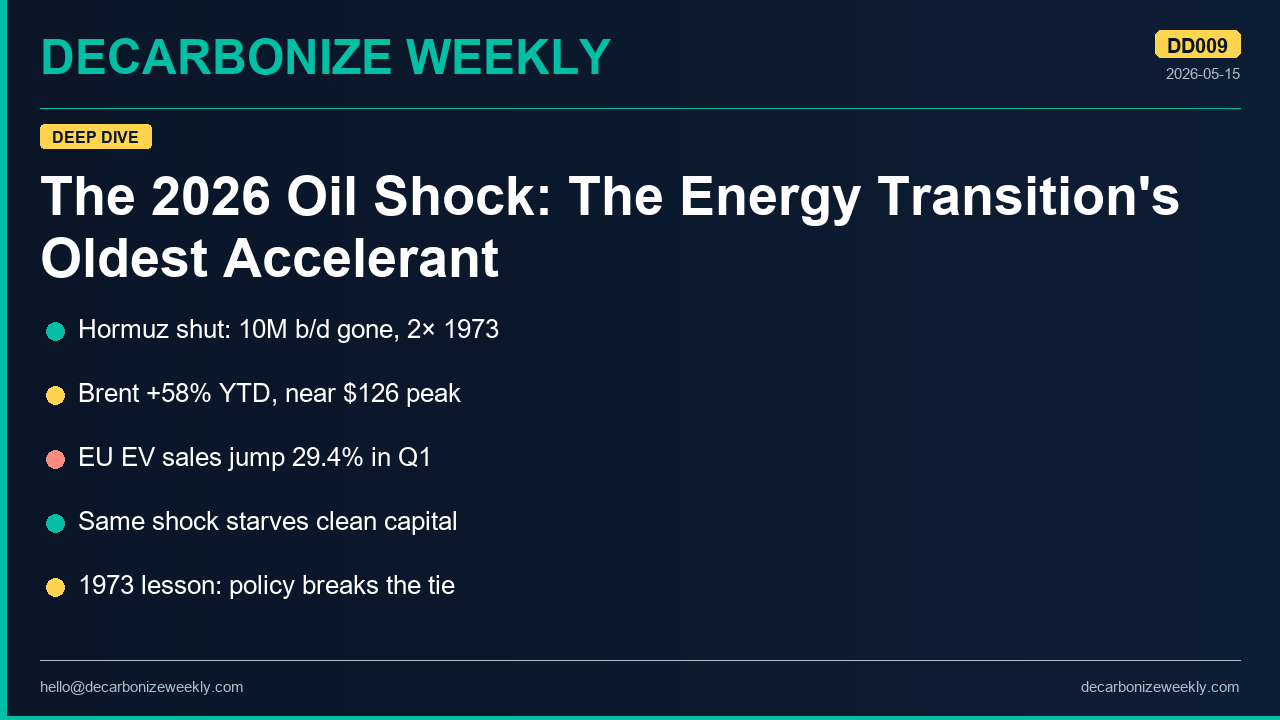
- The shock: the Strait of Hormuz closed February 28, 2026 and has now run eleven weeks. The IEA calls it the largest oil supply disruption in the history of the global oil market — more than 10 million barrels a day removed, against roughly 5 Mb/d in each of 1973 and 1979. Brent peaked near $126 in April, sits around $100 in mid-May, and is up about 58% year-to-date. Global inventories are draining toward an eight-year low.
- What makes 2026 different: every oil shock since 1973 has accelerated structural change, but this is the first to land on an economy where the alternatives — EVs, heat pumps, grid storage, electrified freight, sustainable fuels — are mature enough to actually absorb displaced demand. The dominant response can be demand substitution (permanent fuel-switching) rather than demand destruction (using less, which reverses when prices fall).
- The accelerant is already visible in the data. European battery-electric vehicle sales rose 29.4% in Q1 2026, with analysts attributing part of the surge to higher petrol prices. EVs were roughly one in four new cars sold worldwide in 2025. Solar PV led global energy demand growth for the first time ever, and in mid-May IRENA confirmed solar and wind are now the cheapest sources of power.
- The same shock starves the transition of capital. It adds an estimated 0.8% to global inflation and raises stagflation risk, pushing central banks to hold interest rates higher for longer — a tax that falls hardest on capital-front-loaded clean energy. At $100 Brent, new oil and gas is the highest-return trade on the board, and affordability politics shrink the space for transition policy.
- The tie-breaker is policy. History's verdict from 1973 is clear: economies that locked in structural change — efficiency standards, building codes, the strategic petroleum reserve — decarbonized faster for decades; the ones that just drilled more bought the 1979 shock. A standard passed at $100 Brent still works at $60. A tightening EU has the machinery to convert a price signal into policy; a deregulating US relies on the signal alone.
The Setup — Eleven Weeks That Became a Structural Input
On February 28, 2026, the Strait of Hormuz closed. By mid-May, that closure has run for eleven weeks — long enough that it is no longer a news event but a structural input into every energy decision being made on the planet.
The Strait normally carries roughly a quarter of the world's seaborne oil and a fifth of its liquefied natural gas. The International Energy Agency calls this the largest supply disruption in the history of the global oil market, and the numbers back the claim. The 1973 OPEC embargo and the 1979 Iranian revolution shock each removed about 5 million barrels a day. Hormuz has removed more than 10 million. This shock is roughly twice the size of the ones that built modern energy policy.
The price tells the story. Brent crude peaked near $126 a barrel in April. By mid-May it sits around $100 — still up about 58% since the start of the year. Global oil inventories are draining toward an eight-year low; Goldman Sachs estimates stocks could fall to the equivalent of 98 days of global demand by the end of May.
Here is the framing worth adopting. Almost all coverage of this shock asks one question: how high do prices go? That question is saturated — every outlet on earth is answering it. Decarbonize Weekly asks a different one. Does an oil shock of this size accelerate the energy transition, or stall it? That question is genuinely open, and the answer matters far more than next month's Brent print.
Why History Says "Accelerate" — and Why That's Only Half the Story
Start with the 1970s, because the 1970s wrote the template. The response to the 1973 and 1979 shocks ran on three levers. Use less — efficiency. Find more — non-OPEC oil from the North Sea, Alaska, Mexico. Substitute — nuclear power, and the first government-funded renewable energy research.
The single most powerful lever was efficiency. US vehicle fuel economy roughly doubled in the decade after 1975 under what became the CAFE standards. The strategic petroleum reserve was invented in this period. Building codes tightened. And here is the lesson historians draw: the structural responses — the standards, the codes, the reserves — kept delivering for decades after the price spike faded. The "drill more" response did not. It simply set the stage for the next shock.
So history's first verdict is clear: oil shocks accelerate structural change. But there is a reason 2026 is not just 1973 with a bigger number.
In 1970, renewables generated less than a quarter of one percent of the world's electricity. There was no electric vehicle industry. No heat pump market at scale. No grid battery. A driver or a factory facing the 1973 price spike had essentially one move: consume less. Economists call that demand destruction, and it has a crucial property — it reverses. When prices fall, the demand comes back.
2026 is the first oil shock where the dominant response can be demand substitution instead of demand destruction. Substitution means permanently switching fuels — oil to electricity. And substitution does not reverse when prices fall. The EV bought during the shock is still an EV at $60 Brent. That is the structural difference, and it is the reason this shock could matter the way 1973 did — while landing on an economy that finally has somewhere to send the displaced demand.
The shock simultaneously pulls demand toward electricity and raises the cost of building the electric supply. Both effects are immediate. The tie-breaker is policy.
The Evidence the Accelerant Is Already Working
This is not theoretical. The substitution channel is already visible in the data, one quarter into the shock.
In the first quarter of 2026, battery-electric vehicle sales in the main European markets rose 29.4% — and analysts explicitly attribute part of that surge to higher petrol prices following the war on Iran. That is the shock showing up as permanent fuel-switching within a single quarter.
Step back to the global picture. EVs were roughly one in four new cars sold worldwide in 2025 — 21 million units. Solar PV, separately, was the single biggest contributor to the growth in global energy demand last year — the first time in history a modern renewable has led demand growth. And in mid-May, IRENA confirmed that solar and wind are now the cheapest sources of power, with co-located hybrids delivering near-round-the-clock electricity at fossil-competitive cost in high-resource regions.
So the off-ramp exists, it is cost-competitive, and the shock is pushing traffic onto it. If the story ended there, this would be a victory lap. It does not end there.
The Other Half — Why the Same Shock Starves the Transition
Here is the uncomfortable part. The exact same shock that creates the demand pull also raises the cost of building the supply.
Clean energy is capital-intensive in a very specific way: it is almost all upfront capital with near-zero fuel cost. That makes its economics dominated by the cost of borrowing. Oil and gas production is different — ongoing fuel and operating cost, but faster payback. Now run the macro. This shock is estimated to add about 0.8% to global inflation, and it raises the risk of stagflation and recession. Central banks respond by holding interest rates higher for longer. And higher-for-longer rates are a tax that falls hardest on exactly the capital-front-loaded option — the clean one.
At the same time, a $100 Brent price makes new oil and gas production the highest-return trade on the board. Capital is not sentimental. It flows to the barrel, not the battery.
And there is a third drag, the political one. The IEA's own work on energy price shocks makes the point bluntly: when energy becomes unaffordable, the political space for transition policy shrinks. Voters facing a cost-of-living crisis want relief this winter, not a plan for 2040. The shock that should be buying political cover for the transition can just as easily burn it.
So the honest scorecard reads: demand pull, immediate and real. Capital drag, immediate and real. They are happening at the same time, to the same economy, caused by the same event.
The Tie-Breaker: Capital, Channelled by Policy
If the two forces are roughly matched, what decides the outcome? The answer is the 1973 lesson, restated: the tie-breaker is whether policy locks in demand-side structural change during the window when the price signal is doing the persuading.
Think about the time-shape of it. The demand pull is immediate, but it is also fragile — a chunk of it is still demand destruction that reverses when prices fall. The capital drag is immediate too. But the durable payoff — the thing that made 1973 echo for decades — only materializes if efficiency standards, electrified-freight mandates, building codes, and sustainable-fuel supply guarantees get passed while Brent is at $100 and voters can feel why they matter. A standard passed in 2026 still works at $60 Brent. A standard not passed evaporates the moment prices ease.
This is also where the most important structural observation lands. After 1973, "energy security" and "decarbonization" were treated as separate goals — sometimes opposing ones. In 2026 they have converged. The energy system with the lowest exposure to an oil shock is also the lowest-carbon one. Electrify transport, and you cut both your import bill and your emissions. That convergence is the strongest argument for action, and it is brand new to this shock.
It also explains why the same shock will produce wildly different outcomes in different places. The European Union arrives at this shock mid-tightening: ReFuelEU aviation mandates, the Hydrogen Bank, industrial decarbonization funds — it has the institutional machinery to convert a price signal into structural policy. The United States, after 2025, has revoked its federal decarbonization targets and is no longer setting policy toward emissions reduction, though the 45Q carbon-capture credit survives. So the US is relying on the price signal alone. Same shock. One economy has a transmission mechanism; the other has only the raw signal. Watch them diverge.
A standard passed in 2026 still works at $60 Brent. A standard not passed evaporates the moment prices ease.
The Aviation Exception — Where the Shock Exposes a Gap It Cannot Fill
One sector deserves its own segment, because it breaks the pattern: aviation.
Road transport can substitute fast — the EV is sitting in the showroom. Aviation cannot. There is no electric long-haul aircraft. The decarbonization path for flight is sustainable aviation fuel, SAF, and SAF is nowhere near scale. In 2026, SAF production is about 2.4 million tonnes — just 0.8% of total jet fuel consumption. And growth is slowing, not accelerating, on high costs and policy uncertainty.
The shock does one good thing for SAF: by making fossil jet fuel more expensive, it narrows the price gap SAF has always struggled with. Climate Change News reported in early May that the oil crisis could finally boost the struggling SAF industry, and Aviation Week framed the fuel crisis as a potential catalyst for Europe's lagging SAF supply. That is real. But here is the catch: SAF supply cannot scale on a shock timescale. The EU mandate ramps toward 32% SAF by 2040, the UK toward 22%. E-SAF — synthetic fuel from green hydrogen and captured CO2 — becomes obligatory in the UK in 2028 and the EU in 2030. And not one European e-SAF production facility has yet reached a final investment decision.
So aviation is the case where the shock makes the gap more visible without making it smaller. It is a structural, decade-scale beneficiary at best — and a cautionary tale about assuming a price signal alone can build an industry that needs a decade of capital.
Clearing Up What People Get Wrong
"High oil prices are automatically good for clean energy." No. They create demand pull and simultaneously raise capital costs and make fossil supply the most attractive investment. The net effect is a policy choice, not an automatic win.
"This is just 1973 again." No — the disruption is roughly twice as large, and unlike 1973, the alternatives exist at scale. The shock is bigger; so is the off-ramp.
"The transition accelerates on its own now, because EVs are cheap." Substitution accelerates on its own. Structural change does not. The durable gains from 1973 came from standards passed during the window, not from the spontaneous price response.
"SAF is the immediate winner." SAF's economics improve, but its supply cannot scale in 2026. The immediate winners are road electrification and efficiency.
"Markets are pricing this correctly." Multiple analysts argue markets are under-reacting to a second-wave risk. The full transmission of this shock may not be visible yet.
The Realistic Outlook
The base case — the most likely outcome — is a partial accelerant. Road electrification and efficiency get a durable demand boost; the European BEV data is the leading indicator, and it will persist because substitution is permanent. But the capital drag is real: clean-energy project financing stays expensive through 2026 and 2027, and some marginal renewable and hydrogen projects slip. Net result — a transition that moves modestly faster on the demand side and modestly slower on the supply-build side.
The upside case: Europe and other tightening jurisdictions treat 2026 as their 1973 — passing efficiency standards, freight-electrification mandates, and SAF supply guarantees while the price signal provides political cover. If that happens, 2026 is a genuine inflection point.
The downside case: stagflation deepens, affordability politics dominate, capital floods into fossil supply, and the policy window closes without structural change. Prices eventually fall, substitution partially reverses, and 2026 is remembered as a missed decade.
Four things to watch through the rest of 2026: Does European and Asian BEV-share growth hold through the second half of the year? Do any tightening jurisdictions pass demand-side structural policy during the shock? Does a European e-SAF facility reach a final investment decision? And — the master signal — where does capital actually go: track clean-energy project finance against upstream oil capex.
The technology question is settled. Whether 2026 becomes the transition's inflection point or its stall turns entirely on where the capital goes — a choice being made right now.
Bottom Line
The 2026 oil shock is the largest in history and the first to land on an economy with a real off-ramp. The technology question is settled — EVs, renewables, storage, and efficiency are all mature and cost-competitive. What is not settled is whether this becomes the transition's inflection point or its stall, and that turns entirely on capital allocation.
The shock pulls demand toward electricity and, in the same motion, raises the cost of building the electric supply. History's verdict from 1973 could not be clearer: the economies that converted the shock into permanent demand-side structural change decarbonized faster for decades; the ones that just drilled more bought the next shock.
In 2026 the off-ramp finally exists. Whether anyone takes it is a choice being made right now.