Key Takeaways
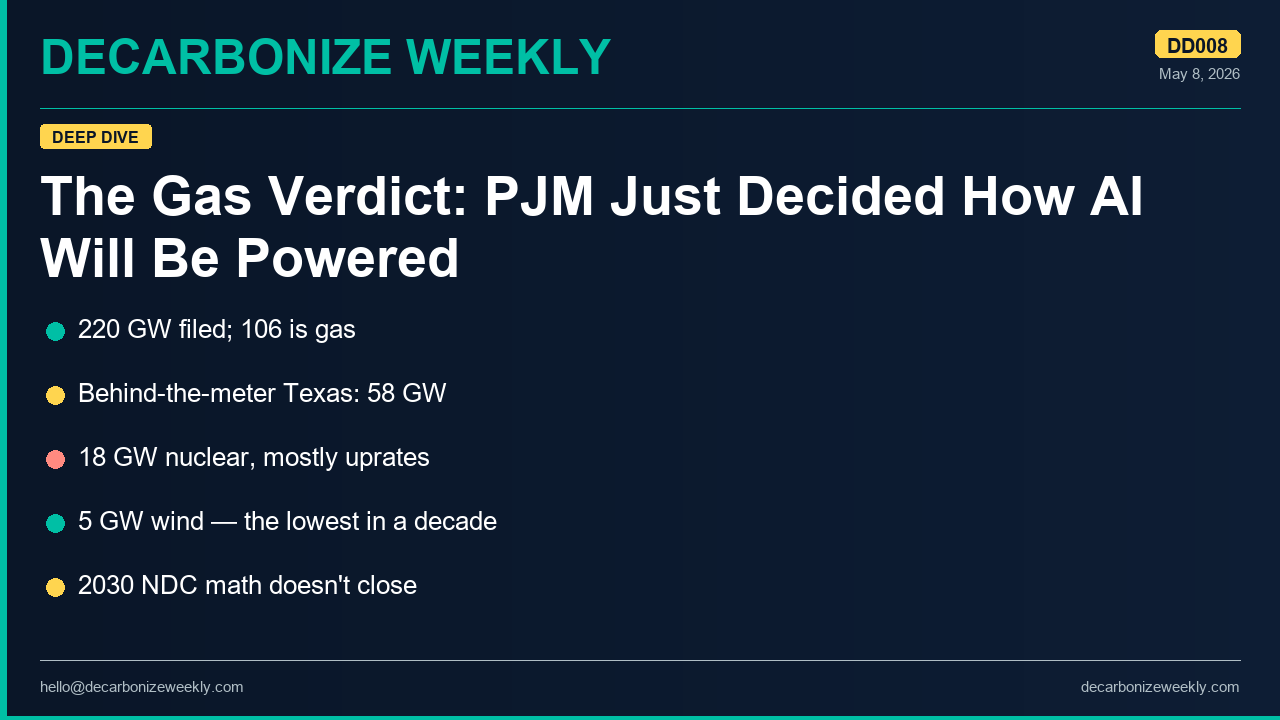
- PJM Cycle 1 (announced April 29, 2026): 811 projects, 220 GW total. 106 GW natural gas (48%), 67 GW battery storage (30%), 18 GW nuclear (8%), 15 GW stand-alone solar (7%), 9 GW solar-storage hybrid (4%), 5 GW wind (2%). Gas is the largest single category by a 6-to-1 margin over solar — the lowest renewable share PJM has filed in a decade.
- Texas runs in parallel and bypasses the public grid: ~58 GW of natural gas in planning, nearly half explicitly behind-the-meter for data centers. Pacifico's 7.7 GW GW Ranch project (permitted January 2026) is the largest gas plant approved in the United States — on a private grid, off ERCOT, invisible to retail rates and to state climate plans.
- Five variables make gas win, and they all point the same direction: speed of build (18–30 months for combined-cycle vs. 6–10 years for a new SMR), capacity factor (90%+ vs. 25% solar), capital intensity matched to cheap Marcellus gas, behind-the-meter site control, and the federal regulatory dismantling completed in the 2025 budget reconciliation.
- The 67 GW of battery storage in the queue is large but supplements gas more than it replaces it. Storage shifts when energy is delivered; if the marginal kilowatt-hour going in came from a gas plant, storage is gas-shifted-in-time. The 18 GW of nuclear is mostly uprates and restarts, not commercial SMRs — the SMR pipeline doesn't scale until the 2030s.
- State climate plans need to be rewritten. Maryland 50% RPS by 2030, Virginia VCEA 100% by 2050, New Jersey, Illinois CEJA — all calibrated against a renewable-heavy queue that Cycle 1 has now structurally displaced. Gas plants approved in 2026 will operate for 30+ years — locking in emissions through 2056.
The Setup — A Queue, an Announcement, and a Verdict
PJM Interconnection is the regional transmission organization for 13 US states plus DC. It is the largest electricity market in North America by served population — 67 million people, roughly 20% of US electricity demand. PJM does not own generation; it dispatches and balances generation operated by hundreds of utilities and independent power producers. New generation cannot connect to the PJM grid until PJM has studied the request — for thermal limits, voltage stability, reliability impact, and required network upgrades.
The interconnection queue is the line of generation projects waiting for that study. By 2022, PJM's queue had become a backlog of more than 200,000 megawatts — mostly speculative renewable projects that had filed early to lock a queue position but had no land, no financing, and no offtake. The study process bottlenecked. New legitimate projects waited 4–6 years for a position. In late 2022 PJM stopped accepting new applications. From 2022 to early 2026, the queue effectively closed.
The reformed process that opened in 2026 changed two things. First, "first-ready, first-served" — projects with site control, executed offtake, and demonstrated financial commitment move ahead of speculative entrants. Second, deposits and milestone fees materially increased, filtering out the casual filers. The reformed queue was intended to reflect actual buildable projects, not speculative paper.
So when PJM announced application results on April 29 — 811 projects, 220 GW — those were 811 projects with real money and real intent. That is what makes the gas dominance the actual signal of where the industry is putting its chips.
220 GW filed; 106 is gas. 5 GW wind, the lowest in a decade. The reformed queue was supposed to reflect what actually gets built. It does — and what gets built is gas.
Why Gas Wins — The Five Variables
The queue is half gas not because the developers writing checks for these projects are climate villains. It is because, given the constraints they face, gas is the option that pencils.
Speed of build. A combined-cycle gas plant takes 18–30 months from permit to commercial operation. A solar-plus-storage project of equivalent firm capacity is comparable on schedule but cannot match the dispatchability profile data centers want. A nuclear restart — Three Mile Island Unit 1, Palisades — takes 4–6 years. A new small modular reactor takes 6–10 years from financing close to first power. An enhanced geothermal commercial plant is 3–5 years and only available in specific geologies. Hyperscalers building out 2027–2030 AI capacity cannot wait for the slow options to scale. Gas wins on speed.
Capacity factor and dispatchability. AI training workloads run 70–95% of the time and are particularly cost-sensitive to power interruption — a stopped training run wastes potentially millions of dollars of compute. Combined-cycle gas runs at 90%+ on demand. Solar runs at 20–25%; wind at 30–40%; storage at 4–8 hours typically. Storage paired with renewables gets close to firm on a portfolio basis but requires careful sizing and fails on multi-day weather events. Gas just works.
Capital intensity matched to revenue model. Gas plants cost roughly $700–1,200 per kilowatt installed. Combined with cheap natural gas in PJM's footprint — Marcellus and Utica basin gas often clearing below $2.50 per million BTU in 2026 — the all-in levelized cost of energy is competitive with renewables-plus-storage at the firm-capacity equivalent, and in some PJM zones, cheaper. The buyer cares about dollars per megawatt-hour delivered firm. Gas wins on that metric in the Northeast and Mid-Atlantic right now.
Site control and permitting friction. Behind-the-meter gas at a data center site avoids transmission upgrades, environmental review on transmission corridors, state-level renewable energy zoning fights, and queue position uncertainty. The data center developer controls the timeline. For a hyperscaler racing to deploy capacity, this is decisive.
The federal regulatory environment. The 2025 budget reconciliation — the One Big Beautiful Bill Act, signed July 4, 2025 — accelerated the phaseout of the Production Tax Credit and the Investment Tax Credit for new renewables. It cancelled the 45V Clean Hydrogen Production Credit for projects starting construction after the end of 2027. The Trump administration's EPA reversed the Biden-era 111(b) New Source Performance Standard for new gas plants, which had required carbon capture by 2032. With each policy removed, gas became cheaper, renewables became more expensive, hydrogen became unbankable, and gas-with-CCS became something developers no longer have to pretend to plan for.
The Texas Side — Behind-the-Meter and Off the Grid
PJM is not the only place this is happening. In Texas, where ERCOT operates outside FERC's jurisdiction, developers are bypassing the public grid entirely.
In January 2026, Pacifico Energy received an air permit from the TCEQ for the GW Ranch project in West Texas — up to 7.7 gigawatts of natural gas turbines on a private grid serving data centers. This was, when issued, the largest gas project approved in the United States. It is bigger than most full-state coal fleets. It is dedicated to one cluster of data centers. The power does not connect to the public grid. Ratepayers do not see it on their bills. The state's renewable portfolio commitments do not count it.
The Texas Standard summarized the state of play: Texas has nearly 58 GW of natural gas power in various stages of planning and construction, and nearly half of the power plants under construction in Texas will provide power exclusively to data centers, without connecting to regional energy grids. This is the new normal — private grids, dedicated to AI compute, fueled by gas, invisible to public regulation, fully visible to federal greenhouse gas inventories.
The Anson County Energy Park, the Lancium and Crusoe sites in West Texas, the Stargate / OpenAI / SoftBank Abilene cluster — all are some flavor of behind-the-meter or co-located gas. The pattern is the same in Louisiana, Oklahoma, Pennsylvania, and Ohio — wherever a state's regulatory structure permits behind-the-meter or where a hyperscaler can get private-grid status. The gas verdict is not a PJM phenomenon. It is a US phenomenon.
The Storage Question — Is Sixty-Seven Gigawatts Enough?
A natural objection is that the 67 GW of battery storage in PJM's queue is enormous — bigger than the entire installed US storage fleet today — and that storage is what allows renewables to displace gas. So why isn't the queue's storage count the decarbonization story instead of the gas count?
The answer is that storage by itself doesn't decarbonize anything. Storage shifts when energy is delivered. If the marginal kilowatt-hour going into storage came from a gas plant — which it does in much of PJM at night — then storage is just gas-shifted-in-time. Storage decarbonizes the grid only when paired with new renewable generation that would otherwise be curtailed or unbuilt.
The 67 GW of storage in Cycle 1 supplements the 106 GW of gas more than it replaces it. It smooths the gas duty curve, lets gas plants run at higher capacity factors, captures cheap off-peak gas-fired electricity for resale into peak hours, and arbitrages volatile wholesale prices. It is not a renewable substitute. It is a gas-fleet optimization tool.
Storage shifts when, not what. If the kilowatt-hour going in came from gas, storage is gas-shifted-in-time. Sixty-seven gigawatts of batteries paired with 106 GW of new gas is a gas-fleet optimization tool, not a renewable substitute.
Nuclear's Eighteen Gigawatts — Smaller Than It Sounds
The 18 GW of nuclear in PJM's queue is the second-largest firm clean number after gas, and it is real. But it breaks down in a way that is less commercially-deployable than the headline suggests.
About 5–7 GW is uprates — existing reactors getting incremental megawatts through better cooling, denser fuel, and license amendments. Roughly 4–6 GW is restarts — Three Mile Island Unit 1, Palisades, the long-rumoured Davis-Besse extension. These are real megawatts on schedules a hyperscaler can actually plan against, but the total is bounded by how many shutdown reactors there are to revive. The remaining 6–9 GW is announced new-build small modular reactors — Westinghouse AP300, GE Hitachi BWRX-300, X-energy Xe-100, NuScale VOYGR. None of those have first commercial operation before 2030–2032. Most slip; the schedules are aspirational.
Translation: nuclear contributes meaningfully to clean firm power in 2026–2030 only through uprates and restarts. The new SMR pipeline shows up in the 2030–2035 window. For the buildout that has to be online before then, nuclear cannot match gas on either schedule or installed cost.
State Climate Plans Need a Rewrite
The damage to state climate plans is structural and quantifiable. Maryland's Renewable Portfolio Standard requires 50% renewable electricity by 2030 and 100% clean by 2035. Those numbers were calibrated against the old PJM queue, which was mostly renewables. Cycle 1 has now allocated PJM's near-term interconnection capacity to gas and nuclear instead — and there is no second cycle that can reverse that allocation in time to hit 2030.
Inside Climate News on May 5 published "As PJM Reopens Interconnection Queue, Experts Warn Damage to Maryland's Clean Energy Plans Is Already Done." Maryland Public Service Commission staff and clean-energy advocates argued that gas-and-nuclear allocation of Cycle 1 leaves too few interconnection slots for the renewable projects Maryland's RPS requires. Gas plants approved in 2026 will operate for 30+ years — locking emissions in through 2056.
Virginia's Clean Economy Act (VCEA) requires 100% clean electricity by 2050. New Jersey's Energy Master Plan calls for 100% clean energy by 2050. Illinois's Climate and Equitable Jobs Act (CEJA) calls for 100% clean by 2050 and 50% renewable by 2040. All of those targets were set with assumptions about how interconnection-queue composition would feed buildout. Cycle 1 broke those assumptions. The political options are: revise the targets (politically painful), accept that the gas plants count as transitional (legally sticky), or push the buildout to other states — which is already happening, and which Texas and Ohio are happy to absorb.
The Transatlantic Split Widens
On May 7, 2026 — eight days after the PJM announcement — the European Commission's Hydrogen Bank concluded its third auction. €1.09 billion was awarded across renewable hydrogen production projects, with the lowest winning bid clearing at €0.44/kg. That number is meaningful: it is materially below the €0.55/kg ceiling, the lowest auction-clearing price the Hydrogen Bank has produced, and a real signal that EU subsidy plus EU offtake structure can move bankable hydrogen projects forward.
Same week. Same demand-side problem — how do you decarbonize industrial energy demand? Two structurally different answers. The EU is using regulation, demand-pull (Hydrogen Mechanism, ETS, CBAM, ReFuelEU), and direct subsidy (Hydrogen Bank at €0.44/kg) to force the supply side to clean. The US is letting price and speed dictate. By 2030 the two power systems will look fundamentally different in fuel mix, emissions intensity, and the policy tools available to industrial decarbonization. Companies operating across both jurisdictions will face increasingly divergent operating environments.
Realistic 2026–2032 Buildout Math
Translating PJM Cycle 1 plus the Texas BTM pipeline plus expected Cycle 2 plus everything that closes outside the queue: a realistic 2026–2032 US power-sector buildout looks like 80–110 GW of new gas, 50–70 GW of storage, 30–45 GW of solar, 8–14 GW of nuclear (mostly uprates and restarts), 1–3 GW of geothermal, and a handful of gigawatts of wind. The gas share crowds out solar at the firm-capacity margin and pushes wind almost out of the new-build picture entirely.
What does that mean for emissions? Roughly 100 Mt/yr of CO2 added to the US power sector by 2030 from AI load alone, on a base of about 1,400 Mt/yr today. That is a 7% structural addition to US power-sector emissions on top of an already-stretched 2030 NDC trajectory. Combined with the IRA tax-credit acceleration and the EPA 111(b) rollback, the 2030 power-sector emissions target essentially cannot be hit on the current buildout.
Three policy levers could change this between now and 2030: a federal carbon price (politically dead until at least 2029); EPA 111(b) reinstatement at sufficient stringency to force CCS on new gas (legally contestable, will be litigated); FERC capacity-market reform that prices clean firm power at par with gas (slow, technical, decade-long). None of those is fast enough to redirect Cycle 1.
What This Means for Decarbonization Investors
Gas-and-CCS becomes the second-tier 2030–2035 story. The 106 GW of new gas in PJM's Cycle 1 plus the Texas BTM gas will run for 30+ years. Some fraction of that fleet will need to clean up under the next Democratic administration's reinstated EPA rules — that is the next-decade carbon-capture-on-gas market, structurally larger than today's 45Q-driven CCS pipeline.
Clean firm power is real but second-tier in this buildout window. Geothermal (Fervo, Sage, Eavor), SMRs (Westinghouse AP300, GE Hitachi BWRX-300, X-energy), nuclear restarts. They will be a 5–10% slice of new build through 2032. They will be a much larger slice from 2030 onward as gas-with-CCS becomes the only acceptable new gas under any future carbon price. The 2030–2035 SMR pipeline is where the second wave shows up.
State-RPS REC markets get more interesting. If states cannot meet RPS targets domestically, out-of-state RECs become the cosmetic fix. Watch for Maryland, Virginia, New Jersey opening REC import allowances. The 2026–2028 REC compliance arbitrage is real money.
Behind-the-meter gas becomes a financeable asset class. Pacifico, Lancium, Crusoe, Sabey, and the Stargate cluster are all behind-the-meter financings or co-locations. As the pattern matures, project finance, infrastructure equity, and structured-debt products specific to BTM-data-center-gas will become a real asset class. The earliest movers (Pacifico's GW Ranch, the Pennsylvania Energy Capital Park) are the precedents.
Gas-with-CCS will be the next-decade clean-up market. Clean firm power is the 2030–2035 wave, not the 2026–2030 one. The PJM Cycle 1 announcement is going to read, in 2030 retrospect, as the moment the gas verdict became visible.
Three Things to Watch Through End of 2026
PJM Cycle 2 composition. Cycle 2 opens later in 2026 with a smaller pool of cleared studies. Does the gas share fall as the easy gas projects clear and the harder ones remain? Or does the federal regulatory environment continue to favor gas, holding the share at 45%+? The Cycle 2 mix is the next data point.
Texas behind-the-meter regulation. Does the Texas Public Utility Commission or the Texas Legislature impose any reporting, environmental, or zoning constraints on private-grid data center generation? Or does the BTM pattern continue unconstrained? Watch for moves from the Texas PUC and from Travis County / Harris County environmental authorities.
Maryland PSC response. Does Maryland's Public Service Commission revise the 2030 RPS target downward, push more aggressively on out-of-state RECs, or open a docket on data-center-specific load attribution? The Maryland response will set the pattern for Virginia, New Jersey, and Illinois.
Bottom Line
The cleantech industry has spent the last 18 months telling the AI-data-center-power story as a clean firm power story: geothermal, SMR, nuclear restarts, hyperscaler PPAs with renewables-plus-storage. That story is not wrong. It is a real, growing slice of the answer. But it is not the answer.
The answer revealed in the past seven days is that natural gas — built fast, built cheap, increasingly built behind the meter — is the dominant power source the US is using to meet AI data center load through 2032. PJM's reformed queue is 48% gas. Texas's behind-the-meter pipeline is overwhelmingly gas. The federal regulatory environment favors gas over the alternatives. The economics in 2026, with sub-$3 Henry Hub and abundant Marcellus production, favor gas over the alternatives. The hyperscaler procurement timeline favors gas over anything that takes more than 30 months to build.
This is not a moral story. It is an outcome story. The decarbonized power grid that the US was building in 2020–2024 — wind plus solar plus storage as the cost-leading combo — was being built on a load curve that didn't include hyperscale AI training. AI training arrived as a 30+ GW step change in demand, and the tools available to meet it on the timeline it required are gas. Without a federal carbon price, without EPA 111(b) enforcement, without 45V or capacity-market reform that prices clean firm at par with gas, the gas verdict is durable.
The PJM Cycle 1 announcement is going to read, in 2030 retrospect, as the moment the gas verdict became visible.