Key Takeaways
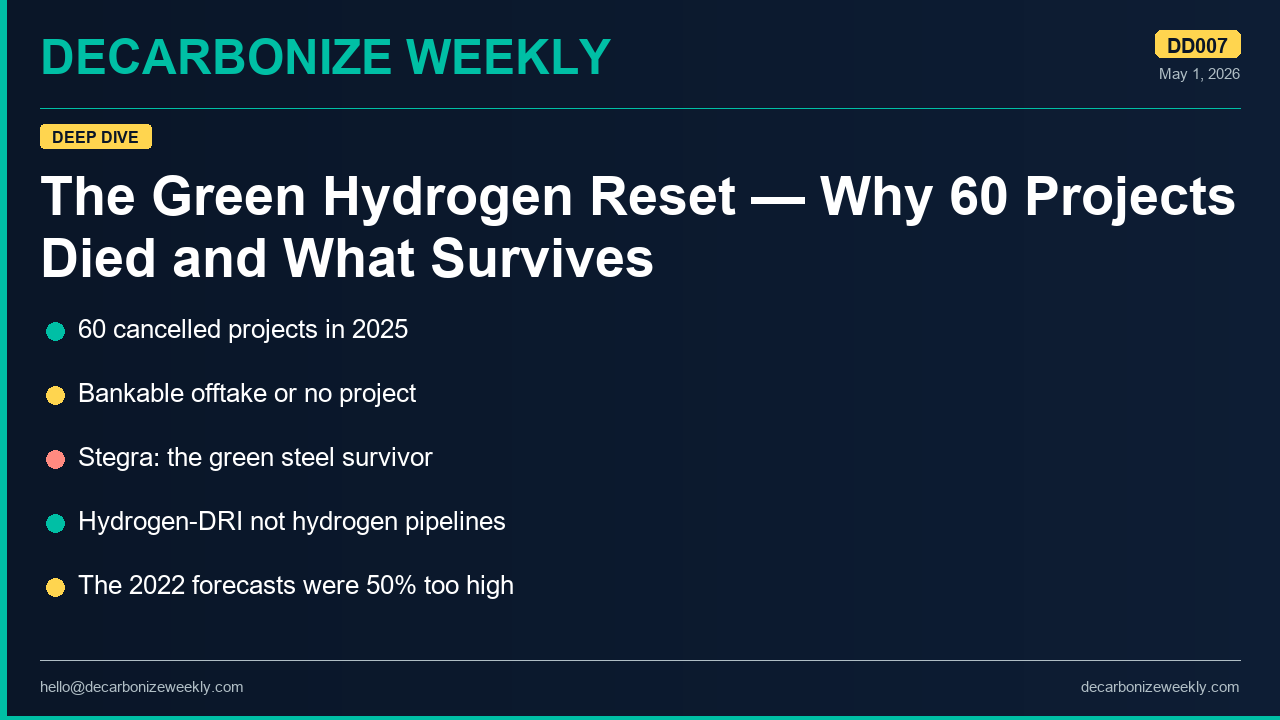
- ~60 major green hydrogen projects were cancelled in 2025 alone — more than 4.9 million tonnes per year of would-have-been capacity. BP exited Australia, Oman, and the UK; Air Products halted three US projects; ArcelorMittal walked away despite €1.3B in committed subsidies.
- FIDs in 2025 actually grew ~20% year-on-year — just on a different shape of project. The survivor template: modular (20–690 MW, not 1.5 GW), captive offtake signed before FID, co-located with cheap firm clean power, sovereign-backed demand, and substituting grey hydrogen at the same site.
- Stegra closed €1.4B in April 2026 against contracted offtake from Mercedes, Porsche, Scania, ZF, BMW and Volvo — the proof that the steel premium ($80–150/t) is small enough for automakers to absorb through car prices.
- Hy24 quadrupled its stake in Spain's Enagás Renovable from 30% to 80% in April 2026 — the dedicated clean-hydrogen PE fund doubling down on a survivor. The trade to watch.
- Realistic 2030 outlook: 25–40 GW operational electrolyser capacity, vs. the 150 GW announcement-base forecast from 2022. Roughly 50% of the way to "as advertised", concentrated in Europe + China + a handful of regional industrial clusters.
The Cull That Defined the Industry
Between mid-2024 and April 2026, the green hydrogen industry had its first real correction. The pattern is not random. Virtually every project that died had three things in common — speculative, large-scale (≥500 MW), targeting export markets, with offtake assumed rather than contracted. Virtually every project that reached or held FID has the inverse profile — modular, co-located with an existing industrial buyer, structured around captive demand or sovereign-backed offtake.
The cull began in late 2024 with Shell Aukra and the Equinor pullout from the Norway-Germany pipeline. It accelerated through 2025: Air Products' three US projects, BP's $36B Australian Renewable Energy Hub, BP Duqm 1.5 GW, BP H2Teesside 1.2 GW blue, ArcelorMittal Bremen and Eisenhüttenstadt, Origin Hunter Valley. It carried into early 2026 with Lhyfe's >100 MW project suspended in April after a missed government grant.
The headline number: roughly 60 major projects cancelled in 2025 alone, representing about 4.9 million tonnes per year of would-have-been capacity. More than 100 projects cancelled, paused, or scaled back globally since mid-2024. About a third of announced electrolyser capacity has been removed from public 2030 timelines.
This is not the death of clean hydrogen. It is the death of speculative clean hydrogen.
~60 major projects cancelled in 2025, ~4.9 Mt/yr of capacity removed. The cull was not random — the failures shared a profile, and so do the survivors.
The Four Economic Gates Most Projects Failed
Any green hydrogen project has to clear four gates to reach FID. The cancellation wave hit projects that cleared one or two and assumed the rest would arrive on time.
Power supply at the right price. Typically <$30/MWh from co-located renewables, with capacity factor high enough to keep the electrolyser running ≥4,000 hours per year. Curtailed renewables don't work; electrolysers want to run base-load.
Bankable offtake. Long-tenor (10+ year) contracted demand at a price that supports debt service — not a memorandum of understanding. This is the gate where the speculative tail died. Buyers wanted long-tenor green-fuel pricing roughly equal to grey-fuel pricing, with the producer absorbing the cost gap. Producers wanted long-tenor pricing that supported $4–6/kg debt-financeable economics. The two sides never met.
Storage and logistics. For export, this means ammonia or LOHC carrier infrastructure. Most projects banked on it materializing for free. It didn't.
Policy stability. Particularly the US 45V tax credit and the EU "additionality" rules. Both moved during 2024 and 2025, breaking project economics built on prior assumptions. The 45V "three pillars" final rules — additionality, time-matching, deliverability — materially reduced the number of US projects that qualified at headline pricing.
The Cost Curve Disappointed
The most under-told piece of the story is that the cost curve drifted upward, not downward, between 2020 and 2025. BloombergNEF's 2020 base case projected $1.40/kg green hydrogen by 2030. The 2025 base case is closer to $4–6/kg. Three drivers: stack cost-down ran roughly 10% per year instead of the 20% per year that planners modeled; balance-of-plant cost ran up under inflation in steel, copper, transformers and labour; and capacity-factor forecasts for solar+wind co-location got revised down as more projects ran in real conditions.
That cost-curve miss is what set up the offtake wall. Buyers who priced 2030 hydrogen at $1.50–2/kg in their 2022 plans cannot sign 10-year offtake at $4–6/kg. Without the offtake, the projects can't raise debt. Without debt, they can't reach FID. Without FID, they don't get built. The chain breaks at the offtake link.
The Survivor Template
While the speculative tail collapsed, FIDs in 2025 grew about 20% year-on-year on count — just on a different shape of project. Five common features:
Captive offtake signed before FID, typically anchored to a steel mill, ammonia plant, refinery, or shipping bunkering hub. Not a buyer-of-last-resort thesis — a customer with a real molecule problem and an existing $/kg purchase price for grey hydrogen.
Co-located with cheap firm clean power. Quebec hydropower at ~$30/MWh-class electricity, Spain's solar-plus-grid, Sweden's hydropower. The export-from-cheap-renewables thesis broke; the buy-cheap-firm-clean-power-where-you-already-are thesis worked.
Modular sizing. Twenty MW to 690 MW, not 1.5 GW. Smaller projects bank faster, derisk faster, and get to first molecule before the policy backdrop shifts again.
Sovereign-backed demand. EU Hydrogen Bank, EU Innovation Fund grants, IRA tax credits where they survived 45V revisions, Korean and Japanese guarantee structures. The projects that took FID through this period mostly had a sovereign somewhere in the cap stack.
"Hydrogen replaces grey hydrogen", not "hydrogen replaces something else". The substitution economics work first where grey hydrogen is already a $/kg purchase — refining, ammonia, methanol, steel. They don't work yet for cars, trucks, residential heat, or grid power, and the cancellation pattern in those use cases (BP, Shell, Hyzon, Nikola, the absence of any serious heating play) tells you the math was never close.
Stegra: The Steel Premium That Cars Can Absorb
Stegra (formerly H2 Green Steel) is the cleanest example of the survivor template. A 690 MW electrolyser feeding hydrogen-DRI plus EAF in Boden, Sweden. Captive offtake signed before FID from Mercedes-Benz, Porsche, Scania, ZF, BMW and Volvo. €1.4B of additional financing closed April 2026, led by the Wallenberg family. Total project capital to date: about €7B.
The math that makes Stegra work: green steel carries roughly an $80–150/t premium over a $700–900/t reference price — about a 10–20% premium at the steel plate level. Translated into a finished car, that premium is on the order of $200–400 per vehicle. An automaker selling a $50,000 vehicle can absorb that through pricing without wrecking the margin structure. That is why automakers signed binding offtake; the customer's product price is wide enough to swallow the green premium.
Compare to ammonia: green ammonia premium is about $200–400/t against a $400–600/t reference — 50–100%. The fertilizer industry can't pass that to farmers; the marine industry needs IMO carbon pricing or a fuel mandate to bridge it. Compare to refining grey-hydrogen replacement: green premium is roughly $1.50–4/kg H2 at the burner-tip, depending entirely on local refinery economics. Without a CBAM-equivalent or a regulated mandate, those premiums sit unbridged.
Steel premium $80–150/t is $200–400 per car — small enough for automakers to absorb through pricing. Ammonia and refining premiums are not. That's the substitution gradient that explains the survivor map.
The PE Survivor Trade: Hy24 Goes to 80% of Enagás Renovable
Hy24 is the only dedicated clean-hydrogen private-equity fund operating at scale. In April 2026, Hy24 took its stake in Spain's Enagás Renovable from 30% to 80% — a controlling position. Within the same window, Enagás opened its gas grid to 35 hydrogen projects, and Belgium's John Cockerill installed 25 MW of alkaline electrolysers at Hyoffwind in Zeebrugge.
For investors looking for a survivor signal in this space, Hy24's quadrupling of exposure is the signal trade. The dedicated specialist with the most pattern recognition in the asset class is doubling down on Spain — cheap solar, an opening gas grid, ports for ammonia export, and a position right in the centre of the EU's emerging renewable hydrogen anchor cluster.
The Plug Power 275 MW Quebec "Courant" project announced in April 2026 is the same template on a different geography: hydropower-class clean electricity, co-located industrial demand, and a Western OEM's PEM electrolyser stack. FID expected late 2026, commissioning 2029. Trafigura's MorGen Energy 20 MW Wales FID is the same template at 1/15th the size — small enough to bank, anchored to refining-related industrial use.
The EU Hydrogen Mechanism Activates
On April 30, 2026, the European Commission's Hydrogen Mechanism activated. It is a centralised market platform connecting hydrogen producers with offtakers across the EU. The portfolio composition tells you which use cases the EU is betting on: 47 ammonia, 37 methanol, 18 e-methane, 14 e-SAF.
This matters because it solves the demand-discovery problem that killed the export mega-projects. The 2022-era model assumed a continent's worth of buyers would emerge to absorb the announced supply. They didn't — not at the price the supply was costed against. The Hydrogen Mechanism inverts that: it structures the demand side first, with public-sector counterparty support, then matches it to producers. Whether it converts paper demand into signed offtake at scale is the next big test — but it is the right shape of intervention, and the first one at EU scale.
One small but telling signal from the same week: pricing service Fastmarkets discontinued two of its weekly European SAF assessments effective April 30, 2026 — a sign that the market is structurally repricing what is and isn't yet a real, traded product.
Forecasts Need to Be Recut
Most national hydrogen demand forecasts — IEA, Hydrogen Council, REPowerEU's 20 Mt by 2030 — were calibrated to the 2022 announcement pipeline. Those forecasts are now roughly 50% over what the bankable pipeline supports. Decarbonization plans built on those numbers, especially in steel, refining, and shipping, need to be recut.
What's actually under construction at end of Q1 2026: about 2.5 GW of operational electrolyser capacity globally (vs. an announced 2030 pipeline of ~150 GW). FID-reached but not-yet-operational adds another 5–8 GW. China dominates the operational base — roughly 60% of installed alkaline capacity worldwide. Europe leads on PEM and SOEC.
Realistic 2030: 25–40 GW operational, total hydrogen demand 75–95 Mt of which 10–15 Mt low-carbon. Most of the gap from 2022's 140 Mt forecast is in the non-captive use cases — transport, building heat, power generation — that simply did not materialize.
Common Misconceptions
"Green hydrogen is dead." No. The speculative tail of green hydrogen is dead. Captive industrial green hydrogen, and selective blue hydrogen near CCS-ready geology, is advancing.
"Cancellations prove it was never going to work." The cancellations prove that certain shapes of project don't work: gigawatt-scale, export-oriented, offtake-on-MOU, single-shot mega-projects in countries without industrial demand. Those shapes failed. Smaller, captive, integrated projects are still reaching FID.
"Blue hydrogen is the answer." Blue has its own bankability problem: it depends on CO2 pipeline + storage infrastructure that is often missing, and on natural gas prices that are volatile. BP's H2Teesside cancellation in December 2025 was a blue project — proof that blue is not automatically more bankable than green.
"$1/kg is achievable by 2030." That was the 45V design point. Without unusually cheap renewables (Quebec hydropower, Patagonia wind, Saudi solar) plus deep tax-credit stacking, the realistic 2030 floor is $2–3/kg.
"China is the export answer." China is producing hydrogen domestically at scale, mostly for industrial captive use, and is the world's largest electrolyser manufacturer. But Chinese hydrogen does not currently flow as a traded commodity to global decarbonization markets — it is internal industrial input.
Five Things to Watch in 2026–2027
Stegra delivery. Will Stegra actually deliver hydrogen-DRI steel at the contracted prices, on the contracted ramp? This is the single biggest signal for whether the captive-industrial template scales beyond the proof-of-concept project.
The EU Hydrogen Mechanism. Does it actually convert paper demand into signed offtake within twelve months, or does it stall on the same offtake-pricing wall that broke the export thesis?
US 45V. Does the US restore 45V's economics to something projects can plan around, or does it stay in regulatory limbo through 2027? The Hydrogen Hubs program survived the administration change but pace has slowed.
Ammonia-as-marine-fuel. Does it cross from pilot to scale, linked to DD005's IMO Net-Zero framework? Marine ammonia is the demand catalyst that could move green-ammonia projects out of subsidy dependence.
The second Stegra. Does another captive-industrial project — in cement, fertilizer, or another heavy-emitting setting — close FID with the same shape of cap stack in 2026 or 2027? One example is a proof point. Two is a template.
Hy24 going from 30% to 80% of Enagás Renovable, and the Wallenberg-led €1.4B for Stegra, are the two trades that tell you what the smart specialist money sees in the wreckage.
Bottom Line
The hydrogen industry that exists in 2030 will be smaller than the 2022 forecasts suggested but materially more bankable. It is anchored to captive industrial demand, modular sizing, sovereign-backed offtake, and customers who can absorb the green premium through their own product price.
For buyers who set decarbonization targets against the 2022 supply forecasts: those numbers need to be recut. For investors looking for survivor signals: Hy24's quadrupling of Enagás Renovable and the Wallenberg-led €1.4B for Stegra are the trades to watch. For policy designers: the cancellation pattern is a clean signal that mandates without offtake structure don't move projects — the EU Hydrogen Mechanism is the right shape of intervention; the US 45V regulatory turbulence is the wrong one.
That smaller industry is real, durable, and financeable. It is not the industry that was advertised in 2022 — but it may be the industry that actually decarbonizes hard-to-abate industrial sectors in time to matter.