Key Takeaways
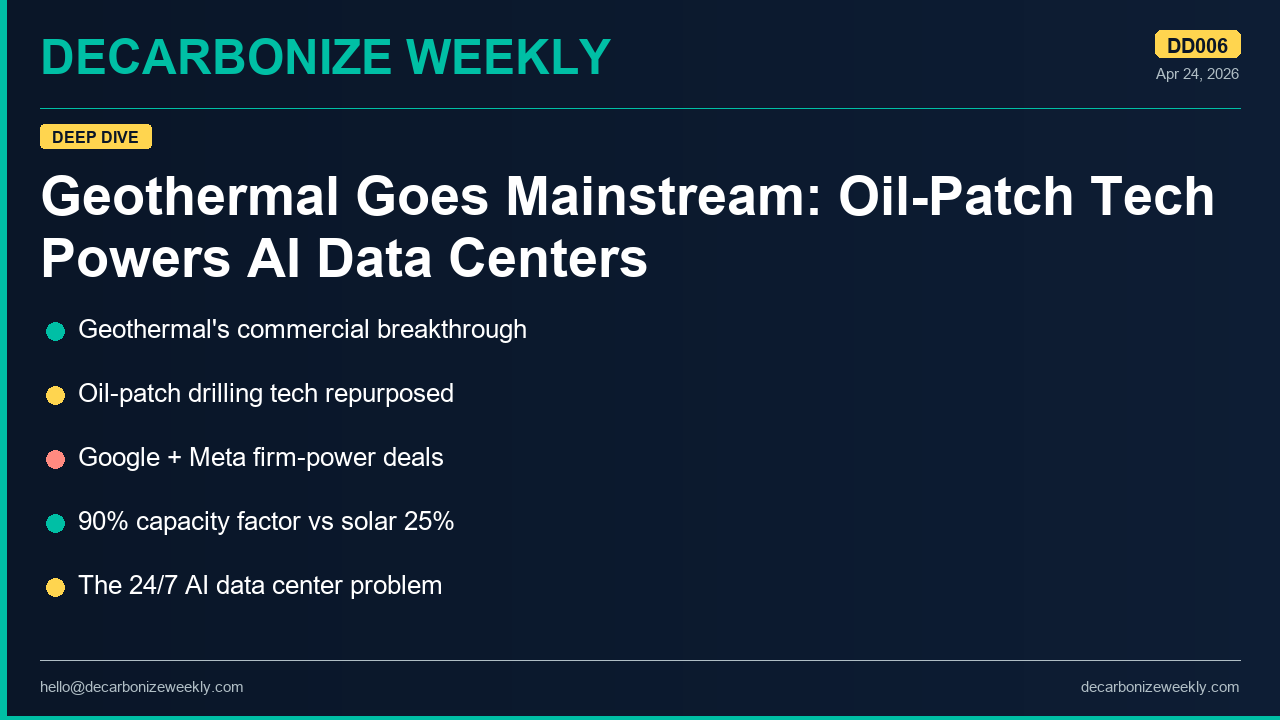
- Enhanced geothermal (EGS) crossed from research project to commercial reality through 2023–2026, anchored by Fervo's Cape Station, Google's multi-gigawatt framework PPA, Eavor's Geretsried, and Sage–Meta's pumped-geothermal storage deal.
- Drilling cost dropped ~70% per well from 2022 to 2024 — horizontal drilling and completion techniques developed for shale oil and gas transfer almost directly to hot dry rock, with the same crews and rigs.
- Hyperscalers need firm clean power on a 3–5 year window. Existing nuclear is limited, SMRs aren't yet commercial, and long-duration storage remains hard beyond ~8 hours. Geothermal is winning the near-term allocation by elimination.
- Capacity factor is the metric that matters: geothermal runs 90%+ vs solar 25% and wind 40%. For a 24/7 AI training cluster, a geothermal MWh is worth 2–3× a solar MWh because it's there when the load is running.
- The oilfield workforce is the under-appreciated supply side: ~300,000 US drilling and completion workers whose skills transfer directly. Geothermal developers are hiring directional drillers out of declining shale basins without training lag.
The Historic Geothermal Problem
Commercial geothermal has existed since 1904 — Larderello, Italy. But total global capacity has stayed tiny. Roughly 16 GW in 2023, against ~1,200 GW of solar and ~900 GW of wind. The reason was geographic: conventional hydrothermal geothermal needs a natural underground reservoir of hot water or steam. Iceland, the Geysers in California, Mount Apo in the Philippines, Olkaria in Kenya. Countries without suitable geology could not play.
Then the 2010s happened to oil and gas drilling. Horizontal drilling plus hydraulic fracturing went down an aggressive learning curve. By 2020, the same rigs, crews, mud systems, and directional drilling services that produced shale were available — often at discount — as crude prices dropped and shale activity contracted.
A generation of engineers, many with oilfield backgrounds, recognized that the shale playbook solved the core geothermal problem. Hot dry rock exists almost everywhere at accessible depths (2–4 km), typically 150–250°C. If you can engineer fractures between two wells and circulate water through them, you have a geothermal reservoir — without needing natural aquifers. This is enhanced geothermal (EGS).
Fervo Energy, founded in 2017 by Tim Latimer (ex-Shell, ex-BHP) and Jack Norbeck (PhD geomechanics), proved the commercial case first. Project Red in Nevada came online in 2023 — 3.5 MW, supplying NV Energy, with Google as the corporate offtaker. That was the first EGS plant delivering into a commercial grid at scale.
Hot dry rock exists almost everywhere at accessible depths. If you can engineer fractures between two wells and circulate water through them, you have a geothermal reservoir.
Why AI Data Centers Changed the Demand Side
At roughly the same time as Project Red was commissioning, the AI training boom started materially changing hyperscaler electricity demand projections. GPT-3 in 2020. ChatGPT in 2022. GPT-4 in 2023. Google, Microsoft, Amazon, and Meta all doubled or tripled their data center capital plans between 2022 and 2024.
Every hyperscaler had public 24/7 carbon-free energy commitments made before the AI boom. Those commitments are now harder to keep, because AI load is continuous, firm, and large — and firm clean power is scarce. Wind and solar give you energy, but not at the hour you want it. Annual REC matching no longer cuts it for 24/7 hourly carbon-free claims.
Hyperscalers operate on a 3–5 year planning window. Within that window, the firm clean options are: existing nuclear (very limited new capacity), SMRs (not yet commercial — first deployment ~2030 if everything lands), long-duration storage plus renewables (economically difficult beyond ~8 hours), and geothermal. By elimination, geothermal is winning the near-term allocation.
By 2024, the two stories — commercial EGS proof of concept, and hyperscaler firm-clean-power demand — collided. The Google–Fervo October 2024 corporate framework for a multi-gigawatt pipeline was the headline collision. Meta–Sage Geosystems followed for 150 MW of pumped-geothermal storage. Microsoft has been publicly exploring geothermal partnerships. The procurement signal is real.
Capacity Factor: The Metric That Settles the Argument
The most important number in power-generation economics is capacity factor — the fraction of nameplate capacity that gets delivered as annual energy. Geothermal runs 90%+. Nuclear runs 90%+. Combined-cycle gas runs about 55% (often less in renewable-heavy markets). Wind runs 35–45%. Solar runs 20–28%.
A 100 MW geothermal plant produces about 800,000 MWh per year. A 100 MW solar plant produces about 200,000 MWh per year. For a hyperscaler trying to power a 24/7 AI cluster, the geothermal megawatt-hour is worth roughly 2–3× a solar megawatt-hour, because it's available when the load is running.
That energy-value gap explains the Cape Station PPA pricing. Reportedly in the low $80s/MWh. That's not cheap on a pure LCOE basis — it's well above utility-scale solar in sunny markets. But on a time-of-delivery value basis for a hyperscaler running a 24/7 training load, it's competitive with new firm clean alternatives, and cheaper than firm solar-plus-storage at 24/7 scale.
The Drilling Cost Collapse
Capital cost is where the EGS story really turned. Typical EGS project capex breaks down: drilling 40–55%, power plant 20–30%, surface facilities and grid interconnect 10–15%, exploration and characterization 5–10%, financing balance.
Drilling is the biggest line item, and it's the line item falling fastest. Fervo has publicly reported a 70% reduction in drilling cost per well from 2022 to 2024. That's not a marginal improvement. That's the kind of learning curve that changes the economics of an entire technology category from "interesting but expensive" to "competitive with new nuclear and cheaper than firm solar-plus-storage at 24/7 scale."
Three things made it possible. First, the shale playbook itself — horizontal drilling, multi-stage hydraulic stimulation, real-time downhole monitoring with fiber optics. Second, the supply chain: oilfield service majors (SLB, Halliburton, Baker Hughes) have all formally entered geothermal through acquisitions and partnerships, bringing equipment scale. Third, the workforce.
A 70% reduction in drilling cost per well from 2022 to 2024. That's the kind of learning curve that changes the economics of an entire technology category.
The Workforce Story Is Underpriced
The US oil and gas industry employs roughly 300,000 drilling and completion workers — directional drillers, completion engineers, MWD/LWD specialists, mud engineers. Their skills transfer almost directly to geothermal. Geothermal developers are hiring experienced directional drillers out of declining shale basins without training lag.
This matters for two reasons. First, drilling cost is dominated by rig-day rates and crew labor. Trained crews move faster, drill straighter, complete cleaner. Performance compounds across wells. Second, there's a political layer: geothermal offers a growth narrative for the same regions and the same workers being squeezed by the broader energy transition. That alignment makes permitting, state-level support, and labor recruiting all easier.
The most consequential strategic question for the oilfield service majors is no longer whether to enter geothermal — they have. It's how aggressively to allocate rig fleets and completion crews to geothermal versus shale, given that geothermal contracts run longer (each project drills 10–30 wells over a multi-year window) but at currently smaller volumes.
Three Architectures Are in Play
EGS (enhanced geothermal): Fervo's approach. Fracture hot dry rock between paired wells, circulate water through the engineered reservoir. Highest heat output per well. Some induced seismicity risk to manage. Best fit for utility-scale baseload.
Closed-loop: Eavor's approach. Sealed wellbore loops conduct heat from rock without fracturing. Lower heat output per well, but no induced seismicity risk. Geretsried in Bavaria — 8.2 MWe + 64 MWth — is the first commercial closed-loop project. Commissioning through 2026.
Pumped geothermal storage: Sage Geosystems' approach. Not baseload generation. Uses pressurized hot rock formations as an energy storage medium — pump water down under pressure, release it later to drive a turbine. The Meta deal for 150 MW signals that hyperscalers are diversifying across firm and stored capacity.
These aren't competitors so much as complementary tools. EGS for big firm baseload. Closed-loop for sites with seismicity sensitivity or smaller heat needs. Pumped storage for grid balancing and load-shifting around variable solar. A mature geothermal portfolio at hyperscaler scale will likely use all three.
What Could Still Break the Story
Three risks deserve honest weighting.
Reservoir performance over time. EGS reservoirs are engineered, not natural. Heat extraction degrades the reservoir over years. Lab and pilot data extrapolates to acceptable decline curves at commercial scale, but those curves need 5–10 years of field performance to be confirmed. If decline is steeper than projected, project economics shift materially.
Induced seismicity. The Pohang earthquake in South Korea in 2017 — caused by an EGS project — set the global EGS permit environment back meaningfully. A single similar incident in a high-visibility US state could repeat that effect. Regulatory frameworks for managing induced seismicity are improving, but they're not bulletproof.
SMR commercial timing. If SMRs land first commercial deployments in 2028 instead of 2032+, hyperscaler firm-clean-power demand could split. Geothermal's near-term advantage is partly because nuclear isn't ready. If nuclear gets ready faster, the demand-side competition intensifies. Most realistic outcomes have both technologies winning allocation, but the share split matters for individual developers.
The Realistic Outlook
Through 2026–2027, expect Cape Station phases to commission, more hyperscaler corporate framework PPAs to land, oilfield service majors to deepen geothermal positions, and the first real production data from commercial-scale EGS reservoirs to start informing the next round of projects. Project InnerSpace's 2024 atlas dramatically expanded the addressable geography — expect more development announcements outside the traditional Western US footprint.
Through 2028–2029, the question becomes whether geothermal can scale from "first commercial wave" to "second commercial wave" — meaning multiple developers operating at gigawatt scale, with cost curves continuing down. That requires the workforce pipeline to keep delivering, the seismicity record to stay clean, and reservoir performance to validate. None of those are guaranteed, but all are on credible trajectories.
Through 2030+, geothermal becomes a meaningful contributor to firm clean power supply alongside nuclear (existing fleet plus first SMRs), with hyperscalers continuing to be the demand anchor. The 16 GW global capacity number from 2023 should look small.
Who Wins, Who Struggles
Likely winners: Specialized EGS developers with proven reservoir performance (Fervo first; Eavor for closed-loop; Sage for storage). Oilfield service majors who allocate capacity intelligently across geothermal and shale (SLB, Halliburton, Baker Hughes). Sensing and data providers — fiber-optic monitoring is a material component of modern EGS execution (Silixa, Luna Innovations, Fotech). Hyperscalers with early framework PPAs locking in supply at today's pricing.
Under pressure: Hyperscalers without a firm-clean-power strategy beyond "buy more solar PPAs." Long-duration storage developers chasing the same hyperscaler dollars with less proven economics. Conventional gas peakers — still the dispatchable default in many markets, but with a credible firm clean alternative now competing for the marginal hyperscaler load.
A 100 MW geothermal plant produces about 800,000 MWh per year. A 100 MW solar plant produces about 200,000 MWh per year. That gap is why hyperscalers are paying for geothermal.
Bottom Line
Geothermal stopped being a 2035 story sometime in 2024. Three things came together: drilling cost dropped ~70% in two years on the back of shale-derived techniques, AI made firm clean power scarce on a 3–5 year horizon, and hyperscalers wrote multi-gigawatt offtake agreements that gave the technology bankable demand. Capacity factor and time-of-delivery value do the rest of the math.
The strategic question for the next two years is no longer whether commercial EGS works. Project Red answered that. It's how fast the cost curve continues, how cleanly the seismicity record holds, and how the share of hyperscaler firm-clean-power dollars splits between geothermal and SMRs as both mature. The episode this week tracks the inflection in real time. The infrastructure layer — drilling, completions, fiber sensing, oilfield service — is where the most under-priced upside lives, because the workforce and equipment are already in place.
If you're in the energy transition trade, geothermal is no longer a side bet. It's a near-term allocation winner with a credible path to scale. Watch Cape Station phase commissionings. Watch the next hyperscaler framework PPA. Watch which oilfield service majors lean in hardest. The 2035 story moved up about a decade.