Key Takeaways
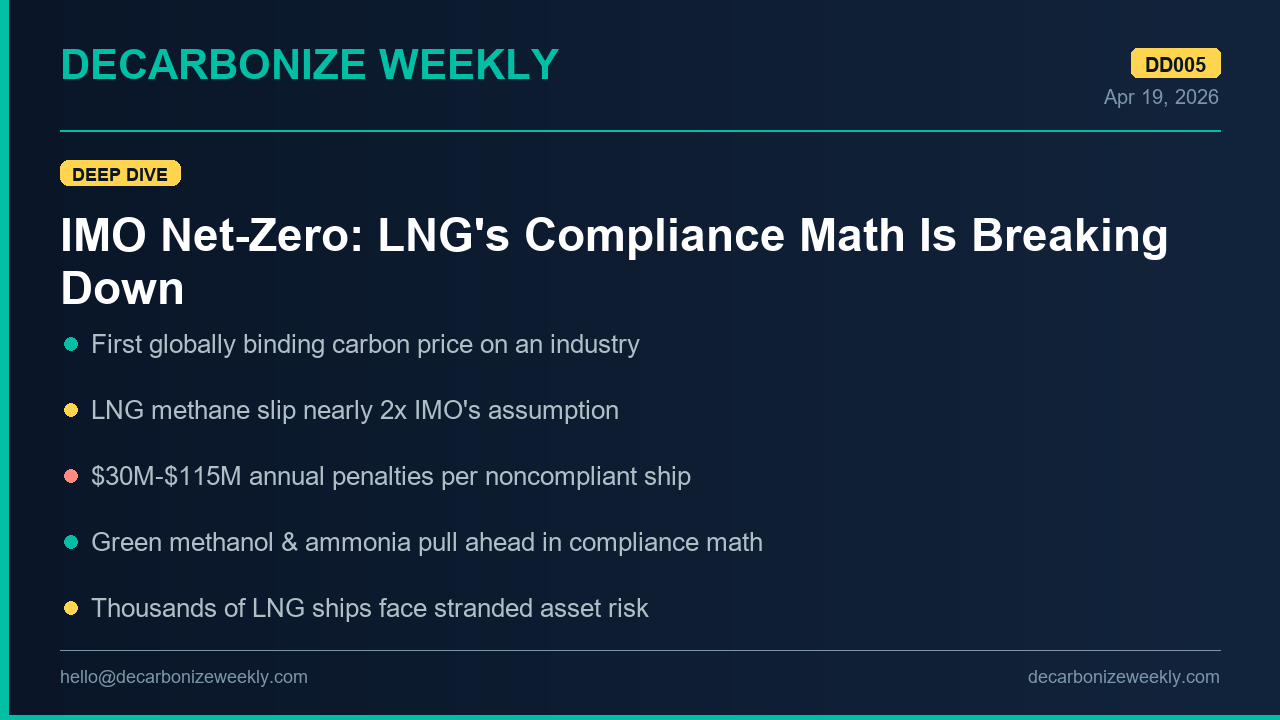
- The IMO Net-Zero Framework is the first globally binding carbon price on an entire industry, with $100–$380/tonne CO2eq penalties for noncompliance starting in 2028.
- Well-to-Wake accounting reveals LNG's real GHG Fuel Intensity is materially worse than industry models assumed: real-world engine methane slip averages 6.4%, nearly double IMO's 3.5% modeled assumption.
- A single 14,000 TEU container ship faces $30M–$115M in annual penalties under Tier 1 or Tier 2 noncompliance — turning thousands of LNG dual-fuel orders into a balance-sheet event.
- Green methanol is in the lead today (112+ ships, Singapore bunkering live for 2026–2030); green ammonia is the long-term Well-to-Wake winner; liquid hydrogen is too early for 2028 compliance.
- MEPC 84 (April 27 – May 1, 2026) is the next signal moment for whether the 2027 entry-into-force and 2028 compliance timeline holds.
The Setup: Why This Framework Is Different
For decades, international shipping operated without any binding greenhouse gas regulation. Climate "strategies" from the IMO set aspirational targets — 50% by 2050, then net-zero by 2050 — but no mechanism enforced them. The Net-Zero Framework, approved at MEPC 83 in April 2025, changes that.
It introduces two binding instruments under MARPOL Annex VI — the same international law that enforced the 2020 global sulfur cap, which transformed 70% of the global fleet within two years of entry into force.
The first instrument is a Global Fuel Standard: every ship of 5,000+ gross tonnes must calculate and report its annual GHG Fuel Intensity (GFI) — a score in grams of CO2 equivalent per megajoule of energy used, calculated Well-to-Wake. The limit tightens every five years through 2050.
The second is a Carbon Pricing Mechanism: ships that exceed GFI limits pay into the IMO Net-Zero Fund at $100/tonne (between Base and Direct compliance targets) or $380/tonne (above the Base Target). Ships that beat the Direct Compliance Target earn surplus units — tradeable with other ships. The Fund distributes proceeds to zero or near-zero emission fuel users.
MEPC 84 (April 27 – May 1, 2026) is the next major milestone. The October 2025 extraordinary session failed to formally adopt the framework after Saudi Arabia successfully moved to adjourn (57–49). MEPC 84 will determine whether the 2027 entry-into-force and 2028 compliance timeline holds.
The IMO Net-Zero Framework is the first globally binding carbon price on an entire industry.
The Core Mechanism: How GFI Works
GFI = greenhouse gas emitted per megajoule of energy, Well-to-Wake.
The 2028 Base Target is 89.6 gCO2eq/MJ. It drops to 65.3 gCO2eq/MJ by 2035. For context:
- Heavy fuel oil (HFO): ~94 gCO2eq/MJ (WtW) — above the 2028 Base Target already.
- LNG (LPDF 4-stroke, 6.4% methane slip): ~75–85 gCO2eq/MJ — dangerously close to the Base Target, likely in Tier 1 or Tier 2 non-compliance by 2030.
- Green methanol (from renewable electricity + green hydrogen): ~4–8 gCO2eq/MJ — earns significant surplus units.
- Green ammonia: ~0–5 gCO2eq/MJ — earns maximum surplus units.
What is Well-to-Wake and why does it matter?
Tank-to-Wake (TtW) counts only what comes out of the engine. Well-to-Wake counts the entire lifecycle: upstream gas extraction and pipeline transport, liquefaction, shipping, bunkering, and combustion. For LNG, WtW includes upstream methane leakage from gas wells and pipelines.
More importantly, WtW counts methane slip — unburned methane escaping from the engine. Methane is 25–30 times more potent than CO2 over 100 years. Real-world measurements of the most common LNG engine type (LPDF 4-stroke) show average methane slip of 6.4% — nearly double IMO's modeled assumption of 3.5%. This destroys LNG's WtW advantage.
The compliance cost is material. Take a 14,000 TEU container ship burning ~85,000 tonnes of fuel per year. If it falls in Tier 1 non-compliance, annual penalties run ~$30 million. In Tier 2, over $100 million. These are per-ship figures. For a fleet operator with 50 vessels, this is a balance sheet event.
Surplus units flip the logic: a ship running green methanol or green ammonia at the same scale earns surplus units it can sell to non-compliant peers, adding a revenue stream that improves the clean fuel economics beyond simple fuel-cost comparison.
The LNG Problem
The shipping industry bet heavily on LNG between 2015 and 2024. The logic was sound on a combustion-only basis: LNG emits ~20–25% less CO2 than HFO. With the 2020 sulfur cap requiring expensive scrubbers or expensive low-sulfur fuel for HFO ships, LNG looked economically and environmentally attractive. Thousands of dual-fuel LNG vessels were ordered by Maersk, MSC, CMA CGM, Carnival, and others.
The WtW accounting switch reveals that assumption was wrong for three reasons:
- Upstream methane leakage is significant. Natural gas production, processing, and pipeline transport involves meaningful methane leakage. Under WtW accounting, this counts against LNG's GFI score before the fuel even reaches the ship.
- Engine methane slip is nearly double IMO's assumption. At 6.4% (measured) vs. 3.5% (modeled), the LNG fleet's real-world WtW GFI is materially worse than the compliance models assumed when ships were ordered.
- The 2030 GFI target doesn't leave room. The framework requires a 21% reduction from the 2008 WtW baseline by 2030. LNG under real-world conditions is unlikely to get there. By 2035, the Base Target of 65.3 gCO2eq/MJ is simply unreachable for LNG at current technology.
This creates a stranded asset problem at industry scale. Ships ordered at $150–$250 million each, designed with 25-year lifespans, are now facing a compliance trajectory their engines were not built for. Options — methane slip mitigation technology, bio-LNG blending, carbon offsets — exist but are expensive, uncertain, and not yet deployed at commercial scale.
At 6.4% measured vs. 3.5% modeled, the LNG fleet's real-world GFI is materially worse than the compliance models assumed when ships were ordered.
The Clean Fuel Race: Methanol vs. Ammonia vs. Hydrogen
Green methanol is currently in the lead. As of 2026, 112+ methanol-capable ships are in commercial operation. Maersk has committed to multi-year green methanol offtake agreements. Singapore methanol bunkering licenses (valid 2026–2030) are creating a regulated supply anchor for Asia-Pacific. Green methanol has a WtW GFI of ~4–8 gCO2eq/MJ — significantly below every target through 2050. The current cost premium (~3–4x VLSFO on energy-equivalent basis) is real but partially offset by compliance incentives and declining electrolyzer costs.
Green ammonia is the long-term WtW winner. Green ammonia's WtW GFI is near zero when produced from renewable electricity via the Haber-Bosch process. No direct carbon emissions at combustion. First commercial ammonia-fueled vessels are deploying in 2026 (Anglo-Eastern, CMB.TECH). But bunkering infrastructure exists at only ~5–10 ports in prototype stages. Safety regulation for ammonia bunkering (highly toxic; requires specialized port protocols) is still evolving in most jurisdictions.
Green hydrogen (LH2) is too early for 2028 compliance. Near-zero WtW GFI. Requires cryogenic storage at -253°C. No commercial maritime bunkering network. Relevant for long-term 2035+ fleet planning, not near-term 2028 compliance.
LNG with bio-LNG blending as a partial bridge. Biomethane/bio-LNG sourced from organic waste has a near-zero or negative WtW GFI (biogenic carbon cycle). Blending bio-LNG with fossil LNG reduces a ship's effective WtW GFI proportionally. This is a compliance strategy available to existing LNG dual-fuel ships — buy a certified volume of bio-LNG, blend it into the tank, reduce your annual GFI. It's expensive per unit of carbon intensity reduction, but it avoids engine retrofits. Limited bio-LNG supply means it cannot solve the entire LNG fleet's compliance problem.
Economics: When Do the Numbers Actually Work?
| Scenario | 2028 | 2030 | 2035 |
|---|---|---|---|
| HFO ship (no change) | Tier 2 penalty: ~$380/t CO2eq | Tier 2 | Tier 2 |
| LNG ship (LPDF, 6.4% slip) | Tier 1–2 non-compliance likely | Tier 2 non-compliance | Far above Base Target |
| Green methanol ship | Earns surplus units | Earns surplus units | Earns surplus units |
| Green ammonia ship | Earns max surplus units | Earns max surplus units | Earns max surplus units |
At $380/tonne (Tier 2), the compliance cost narrows the gap with green methanol by roughly 30–40% in 2028, depending on fuel volumes. The remaining gap closes as green methanol costs decline toward $700–$900/tonne by 2030 (from ~$1,200–$1,800/tonne today) and surplus unit revenues are properly priced.
Green methanol economic parity is not at $380/tonne alone — but the combination of compliance penalty avoidance, surplus unit revenue, and green methanol cost decline over 5 years creates a trajectory toward economic parity by the early 2030s.
The Geopolitics: Why MEPC 84 Matters Now
The October 2025 extraordinary session failure showed that the 130-country IMO consensus is fragile. Saudi Arabia led a coalition of fossil-fuel-exporting states in successfully adjourning the session. The US, under the second Trump administration, had pulled its support for the carbon pricing mechanism, weakening the majority.
MEPC 84 (April 27 – May 1, 2026) is not an adoption session. But it is a signal session. It will show whether implementation guidelines (certification, reporting, GFI calculation methodologies) can advance toward readiness, whether a new extraordinary session will be called for adoption before MEPC 85, and whether the pro-adoption coalition — EU, UK, Japan, South Korea, Pacific island states — can maintain a working majority for the next attempt.
If MEPC 84 produces a clear path to adoption, the 2027 entry-into-force and 2028 compliance timeline is salvageable. If it produces another adjournment, the compliance clock slips by another year — compressing the investment window for alternative fuel infrastructure further.
MEPC 84 is not an adoption session. But it is a signal session.
The parallel from aviation is instructive. CORSIA — the aviation sector's global carbon compliance mechanism — closes its first compliance period (2024–2026) this year. Airlines are buying approximately 200 million Emissions Units for cancellation, at an estimated $1.7 billion cost for 2026 alone. A global sectoral carbon compliance mechanism works when it has political support and enforcement. CORSIA's completion provides political evidence that the IMO framework can work too.
What a Serious Listener Should Do with This
If you work in shipping: your fuel strategy for 2028 is already behind schedule. The compliance clock starts in less than two years. A ship ordered today arrives in 2028–2030. The GFI math for LNG is worse than your models assumed. Green methanol bunkering is available now in Singapore. The question is not whether to plan — it's whether you've started.
If you work in clean fuels: the IMO framework is the demand signal you've been waiting for. A compliance penalty structure that makes noncompliance cost $100–$380/tonne is a hard number you can put into project economics. The bunkering infrastructure bottleneck is real — ports that build methanol and ammonia bunkering early will attract premium traffic.
If you invest in the sector: the LNG fleet stranded asset problem is not hypothetical. The companies best positioned are those with methanol or ammonia fuel strategies already underway: Maersk (methanol), CMB.TECH (ammonia), Mitsui OSK Lines (various), and early-mover port authorities. Classification societies and compliance service providers are structured beneficiaries regardless of which fuel wins.
If you follow policy: MEPC 84 is the first test of whether the IMO Net-Zero Framework survives its political opposition. If it does, this becomes the template for how to decarbonize other hard-to-abate global sectors — aviation, cement, steel. If it doesn't, we learn something equally important about the limits of multilateral carbon governance.